66% of logistics pros say talent quality — not cost — is the #1 factor in choosing a nearshore partner. Rapido's integration model explains why that's the right question to be asking.
Plus, a carrier pleading guilty to mob money laundering while still FMCSA-active, Iran's first post-ceasefire attack and what it means for diesel surcharges, FedEx Freight's first earnings as a standalone company, and more in today's newsletter.
Freight brokers are measuring their inboxes wrong. Most inbound email is monitoring, not work. And the longtail categories that look like noise are costing real margin. Here's how to audit what's actually in your inbox, and why it matters in 2026's margin-first market.
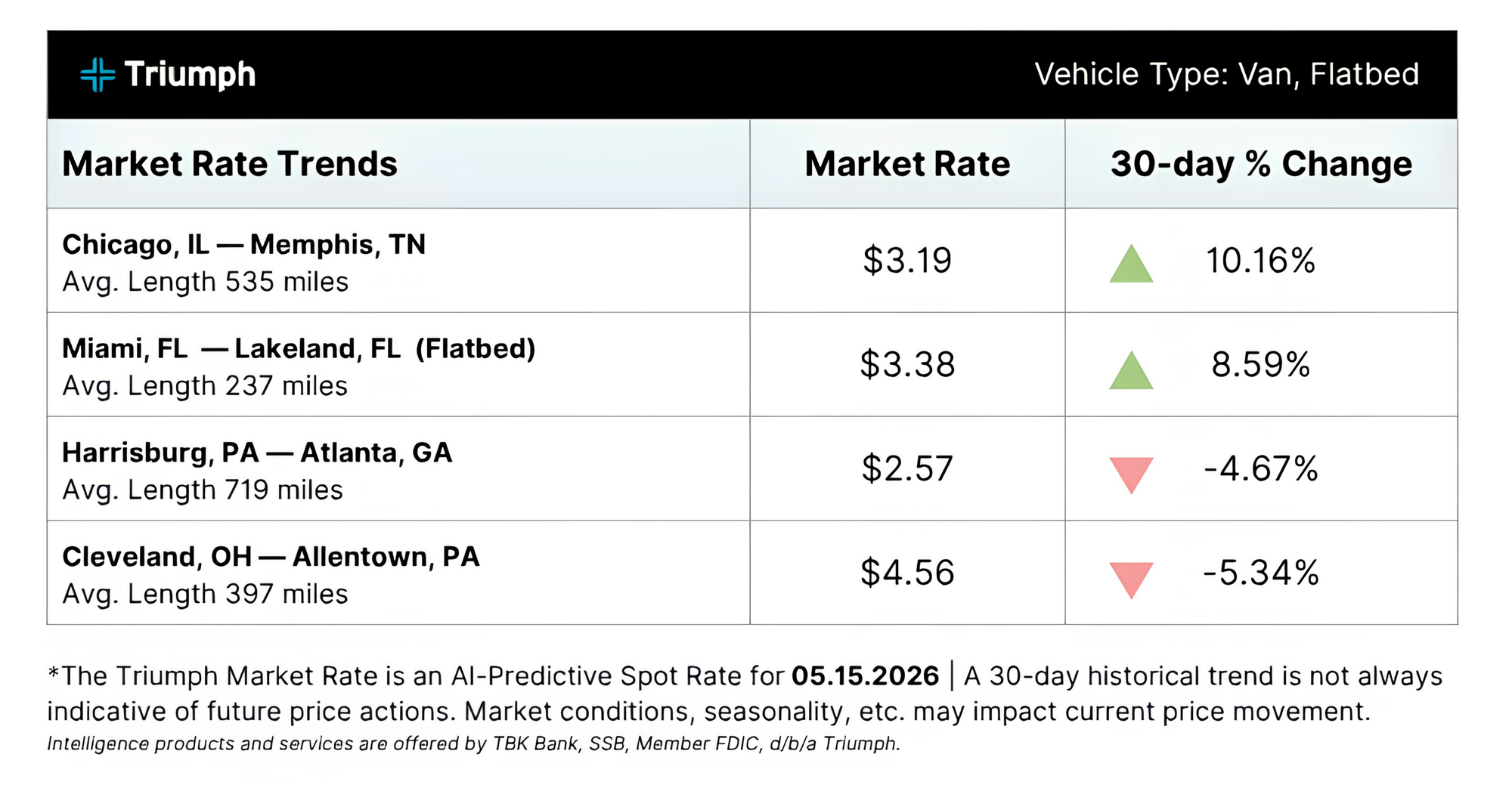
Triumph—trusted for payments and factoring—now delivers Intelligence. Purpose-built to power broker transactions from quote to cash, the Triumph Network equips brokers with insights to accelerate growth and transact confidently.
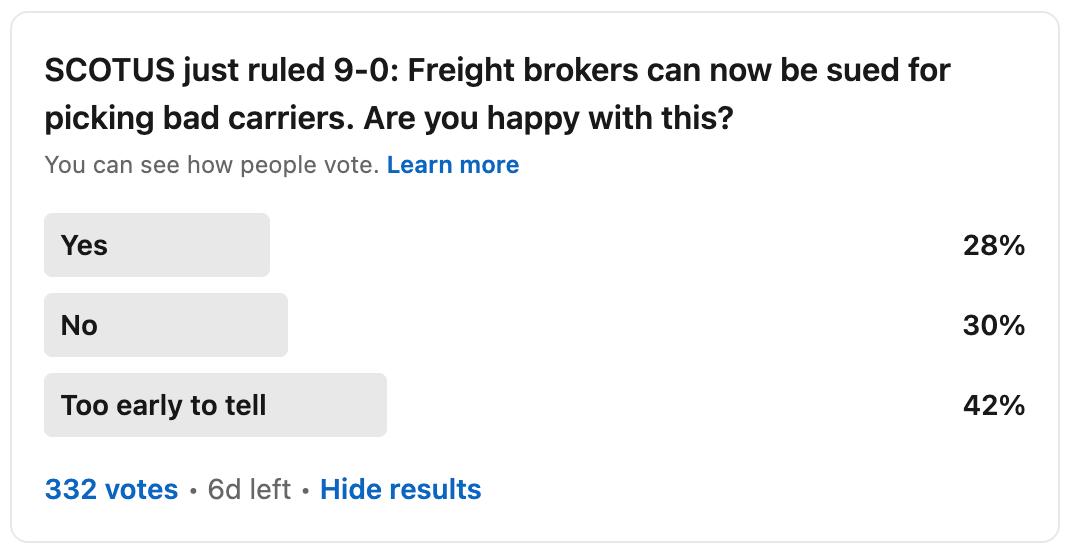
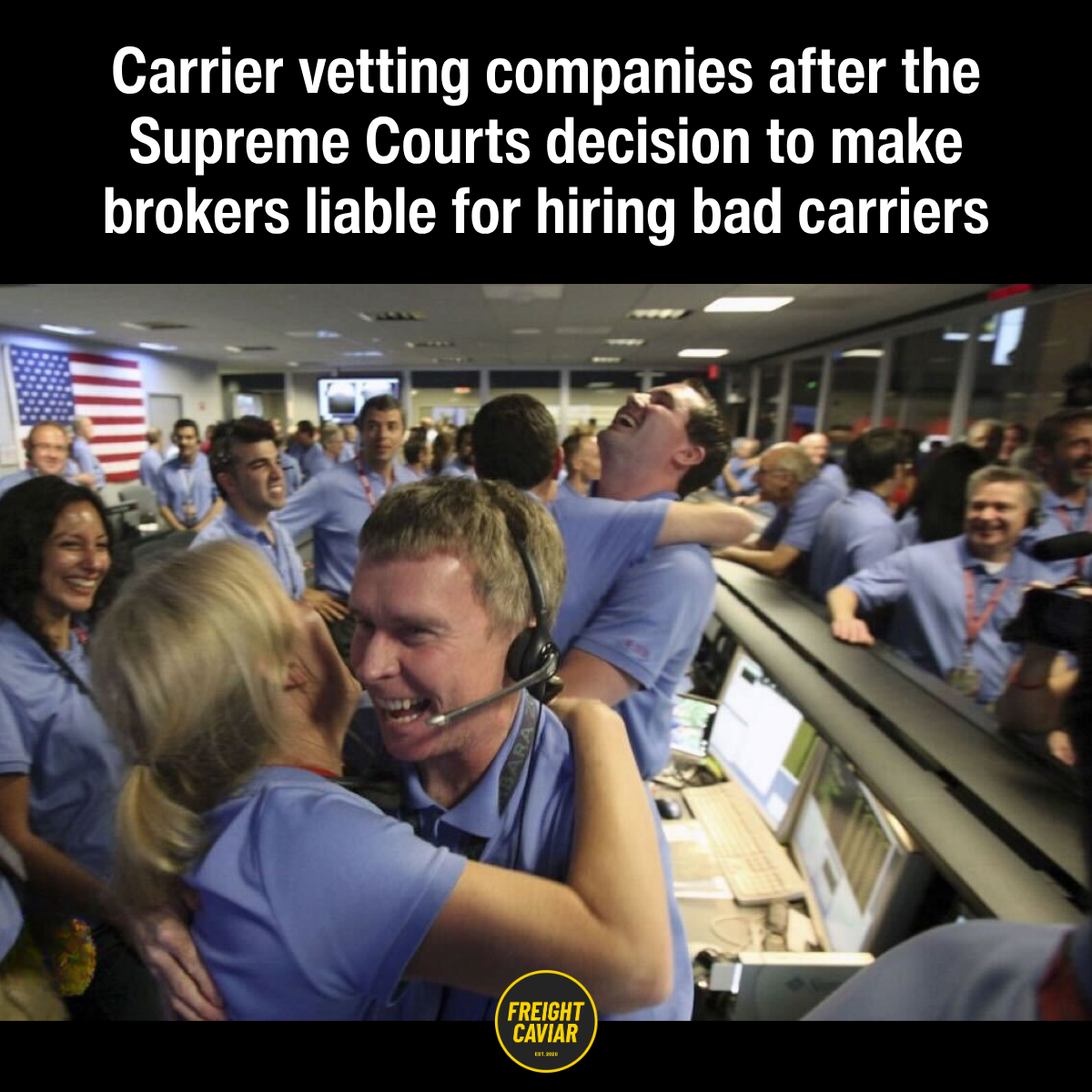
SCOTUS Drops the Hammer on Broker Liability
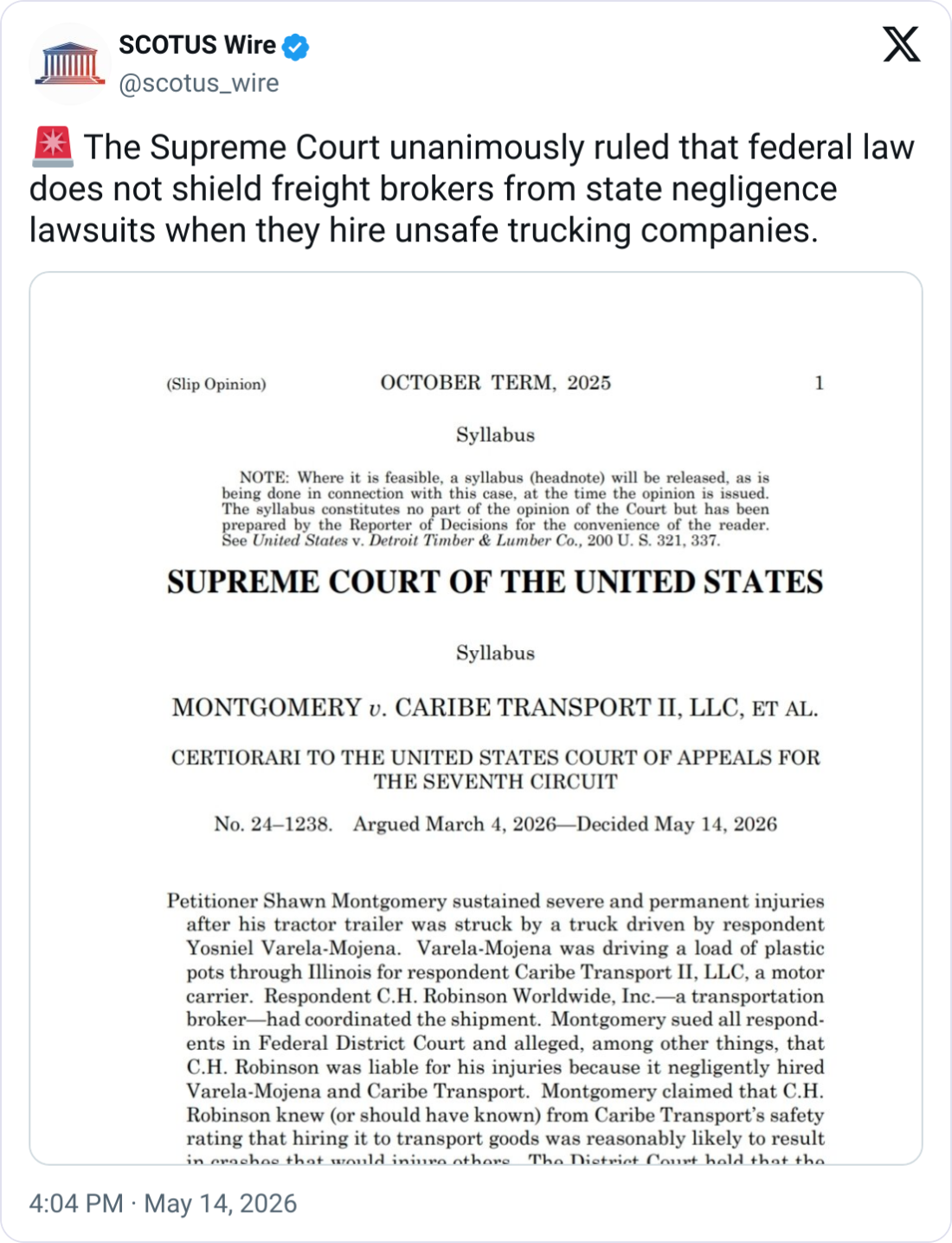
Yesterday (May 14, 2026), the Supreme Court issued a unanimous 9-0 ruling in Montgomery v. Caribe Transport II, LLC, changing the game for every freight broker in America.
In plain English: state negligent-hiring claims against brokers are NOT preempted by the Federal Aviation Administration Authorization Act (FAAAA). Brokers can now be sued in state court if they’re accused of failing to use “ordinary care” when selecting a carrier that ends up in a crash.
The case stemmed from a 2017 Illinois crash. Shawn Montgomery lost part of his leg after being hit by a truck operated by Caribe Transport II. C.H. Robinson had brokered the load. Montgomery sued, alleging the broker knew (or should have known) about Caribe’s conditional safety rating, driver qualification issues, crash history, and yet still put them on the road. The lower courts had tossed the claim under the FAAAA. SCOTUS said no.
“Requiring [the broker] to exercise ordinary care in selecting a carrier concerns motor vehicles. Most obviously, the trucks that will transport the goods.”
Justice Brett Kavanaugh (joined by Alito) concurred and cut straight to the incentive:
“If brokers can be held liable for disregarding poor safety records, they have a strong incentive to do business only with safe and reliable motor carriers.”
Simple Bottom Line: The FAAAA was an economic deregulation law, not a safety deregulation law. The “safety exception” wins. The old preemption shield for negligent selection claims is gone.
The Court made clear: You can still compete on price, but you can’t be reckless with safety.
So… Is This the End of Brokerage as We Know It? (Spoiler: No.)
Freight still moves. Brokers will still broker. Carriers will still haul. This ruling doesn’t ban any business model or create new federal mandates. It simply says states can enforce basic negligence standards when brokers ignore red-flag safety data that’s been publicly available on FMCSA for years.
If you’ve already been doing real vetting (SAFER reports, SMS scores, crash history, insurance checks, and keeping records), you’re ahead.
If you’ve been winging it on price alone, it’s time to tighten up. Insurance premiums will likely rise for some, especially smaller operators with weak processes. But most sophisticated brokers say they’ve already been operating with this risk in mind.
Why This Matters Beyond Brokers
Safety advocates and crash victims see this as long-overdue accountability. Truck crashes still kill thousands every year. This ruling also resolves a long-standing split among federal appeals courts, creating one clear national standard.
Voices from the Industry
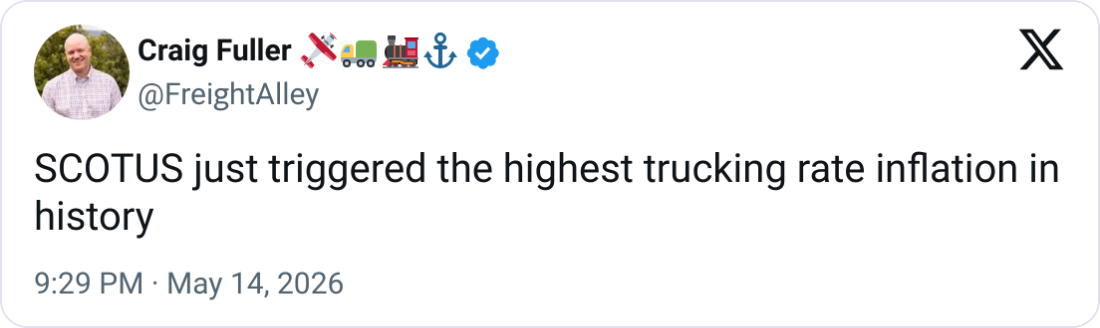
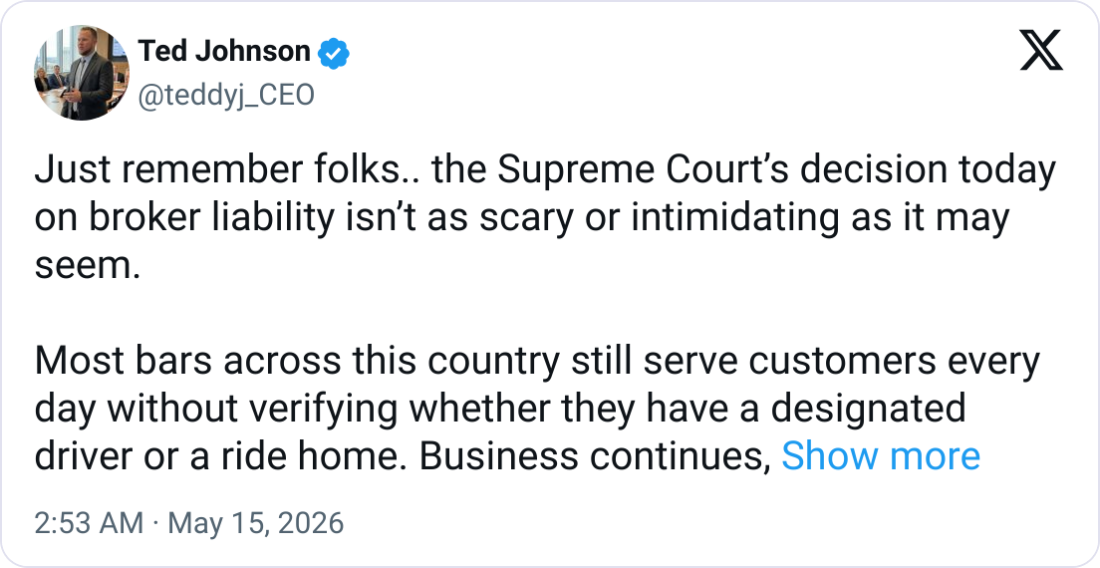
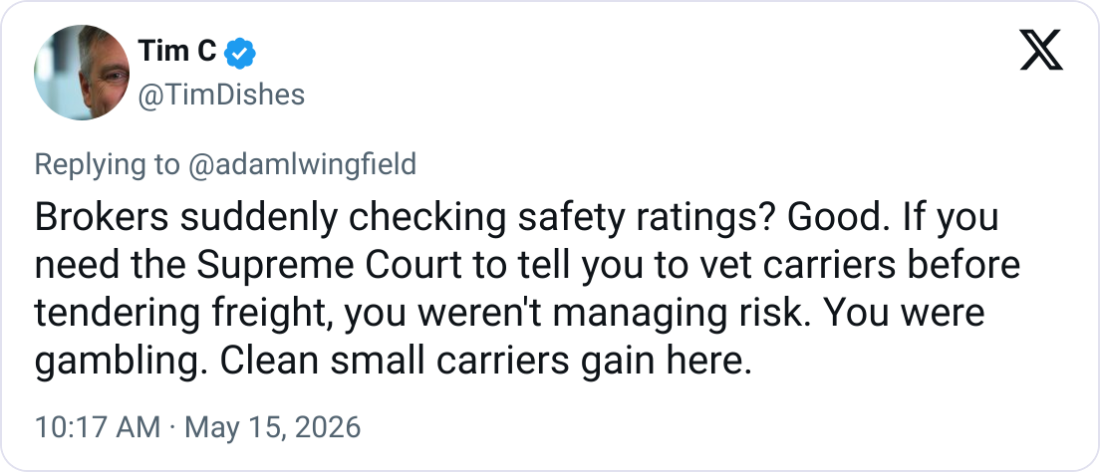
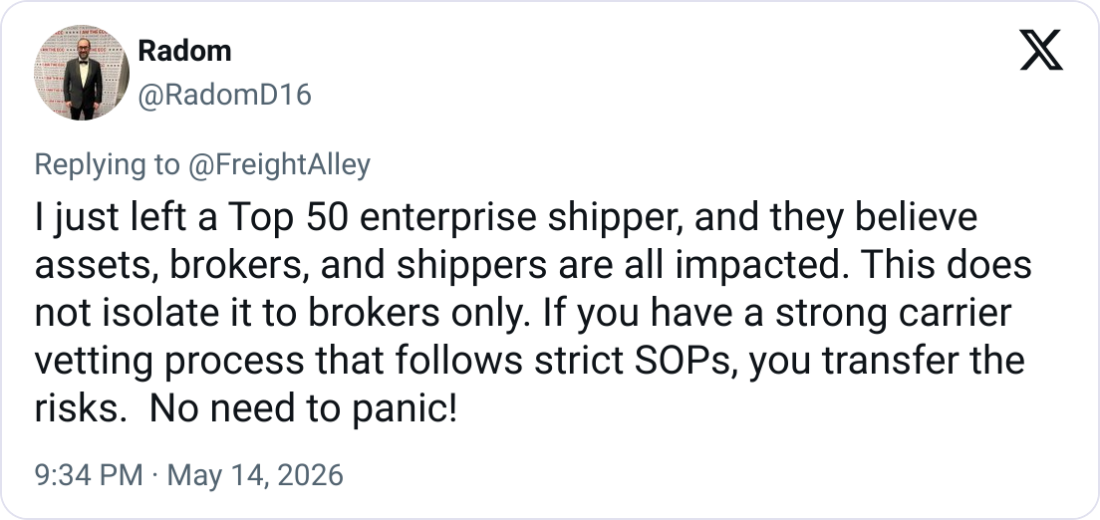
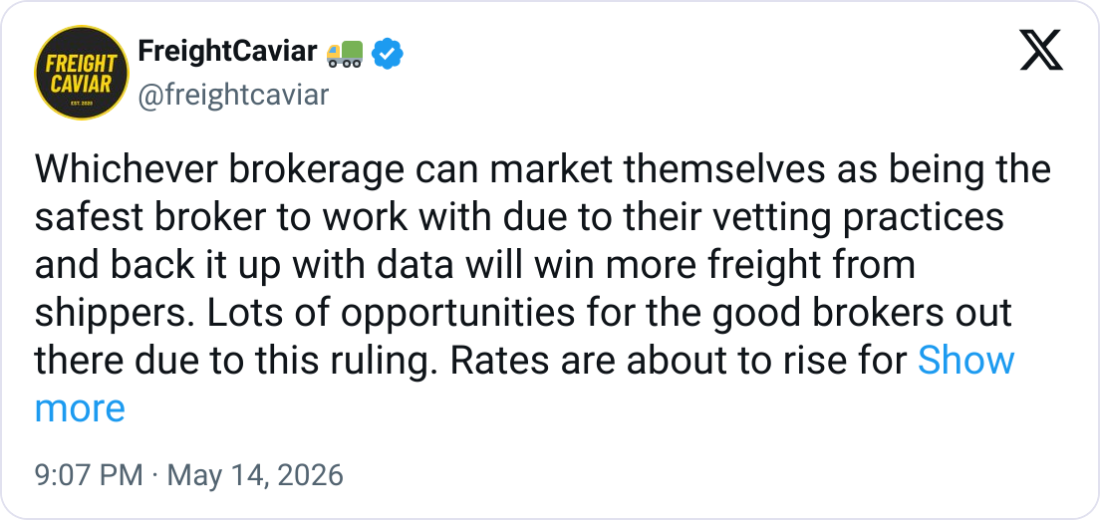
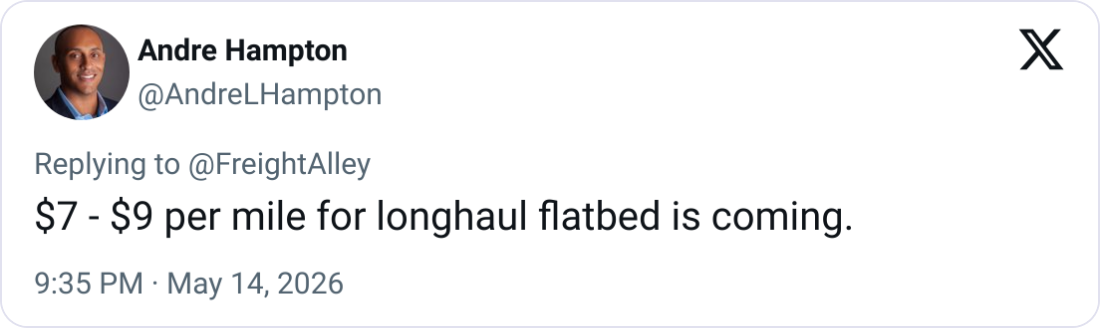
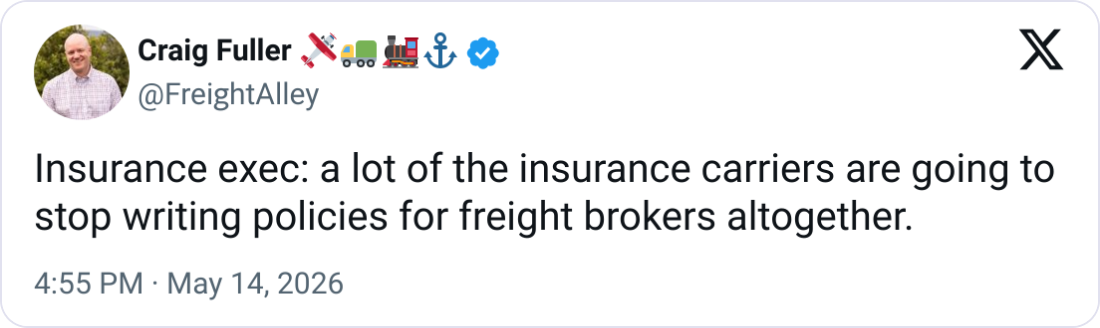
The freight community on X didn’t waste time weighing in.
Balanced Industry Voices
Former MoLo Solutions CEO and host of The Freight Pod, Andrew Silver, posted one of the most grounded reactions on LinkedIn.
Silver, who has 172 days left on his non-compete after selling MoLo to ArcBest, said the ruling actually left him more optimistic about brokerage than he was the day before the decision.
“Don’t believe everything you hear… This is a moment where great brokers will improve, and bad brokers will get worse. As a competitor in the game, I like that.”
Ryan Crawley (Surus Transport) pushed back hard against the narrative that small brokers and carriers are doomed:
“A lot of chatter about small brokerages (and small carriers) going to get wiped out… I’ve got news for you: The majority of hiring negligence comes from the largest brokerages who gobble market share and large volumes… The biggest players have PE and public investors demanding ROI — leaving them no choice but to race to the bottom with carrier selections. Moral of the story: Procurement is more important than ever. Say NO to freight that forces you to book carriers who’d take it under their OpEx. This is a simple game if you aren’t in a race to the bottom.”
RXO said they don’t expect a material business hit thanks to their existing scale and processes.
C.H. Robinson expressed disappointment but pointed to the concurrence for nuance.
The TIA called it disappointing and pushed for federal (not state) standards.
Potential Longer-Term Effects
Insurance: Expect premiums for broker liability coverage to rise, especially for smaller operators with weaker processes. TD Cowen's research indicates brokers currently receive an effective ~90% discount on premiums relative to asset carriers, and expects that to shrink to as low as 10%, approaching parity.
Market shifts: This could accelerate consolidation. Stronger brokers and carriers gain share, while the weakest brokers and carriers exit. Spot rates may firm up as marginal capacity leaves.
Shippers: Many will tighten requirements in broker contracts and may favor partners with robust compliance systems.
Importantly, this does not mean brokers will lose every lawsuit. Plaintiffs must still prove the broker was actually negligent, not just that a crash occurred.
Tightening capacity is changing how brokers price freight, manage carrier networks, and support customer relationships.
GoodShip helps brokers unify operational data, pricing intelligence, carrier performance metrics, and customer-specific insights in one system to improve visibility, protect margins, and make faster decisions in changing market conditions.
Download The Tight Market Playbookfor seven practical strategies to strengthen shipper relationships, improve execution, and operate more strategically in today’s freight market.
Review your carrier selection policy. Make it written, data-driven, and timestamped.
Talk to your insurance broker about negligent-hiring exposure.
Carriers: Polish those FMCSA scores and amplify your safety record.
The Supreme Court didn’t kill the brokerage model. It just said you can’t hide behind federal preemption while putting unsafe trucks on the road.
This is the new normal. Adapt, document, and keep the freight rolling. Stay sharp out there. We’ll keep you posted as the first wave of suits and insurance adjustments hits.
Share your take with us by replying to this e-mail.
Plus, a carrier pleading guilty to mob money laundering while still FMCSA-active, Iran's first post-ceasefire attack and what it means for diesel surcharges, FedEx Freight's first earnings as a standalone company, and more in today's newsletter.
Bad carriers are gaming the weigh station system. Plus, C.H. Robinson's own engineer goes scorched earth on Reddit, the Ghost Truck Act gets roasted, and more in today's newsletter.
Keep up with the freight broker world in 5 minutes.
Join over 14K+ subscribers to get the latest freight news and entertainment directly in your inbox for free. Subscribe & be sure to check your inbox to confirm (and your spam folder just in case).