66% of logistics pros say talent quality — not cost — is the #1 factor in choosing a nearshore partner. Rapido's integration model explains why that's the right question to be asking.
Plus, a carrier pleading guilty to mob money laundering while still FMCSA-active, Iran's first post-ceasefire attack and what it means for diesel surcharges, FedEx Freight's first earnings as a standalone company, and more in today's newsletter.
Freight brokers are measuring their inboxes wrong. Most inbound email is monitoring, not work. And the longtail categories that look like noise are costing real margin. Here's how to audit what's actually in your inbox, and why it matters in 2026's margin-first market.
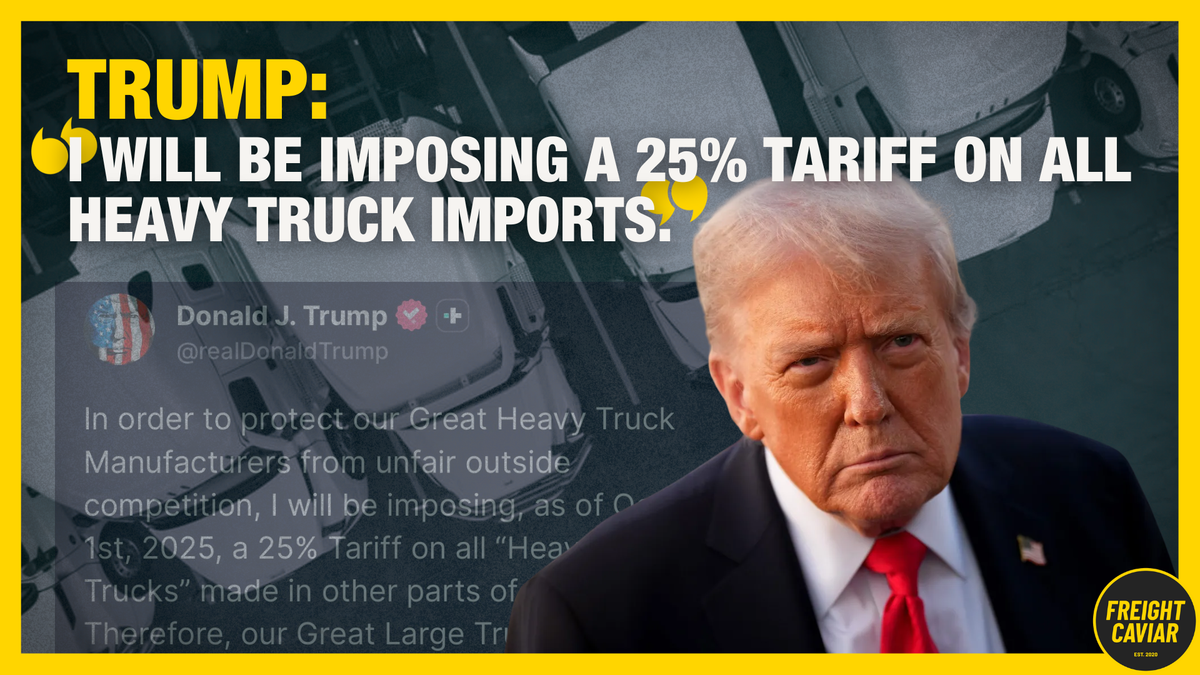
President Donald Trump’s decision to impose a 25% tariff on imported heavy trucks effective Oct. 1 has set off sharp market reactions, lifting Ford shares to new highs while dragging down European truck makers exposed to Mexican production.
Ford Motor Co. surged 3.4% on Sept. 26 to its highest level since July 2024. Options activity exploded, with call trading more than 303,000 contracts compared to a 20-day average of 37,000, according to Roundhill Investments CEO Dave Mazza. “That kind of flow often forces market makers to hedge by buying stock,” Mazza said. Still, Bloomberg Intelligence analyst Steve Man noted that Ford’s limited exposure to Class 7 trucks means “the levies won’t be enough to affect the company’s bottom line.”
European OEMs React Differently
In Frankfurt, Daimler Truck fell as much as 4.9% while Volkswagen’s Traton slid 3.1%. Both firms assemble trucks in Mexico, exposing them to cross-border disruption. By contrast, Volvo AB climbed 3.45% in Stockholm, benefiting from its heavier U.S. footprint.
“The local content of Volvo’s U.S. trucks is between 60% and 70%,” the company said in a statement, though some components still need to be imported. Volvo added, “What we have to go on at this stage is merely a Truth Social post. We should wait to see the actual legislative proposal before we can fully assess its potential effects.”
For Daimler, the U.S. is its largest market, generating about 40% of global sales across brands such as Freightliner and Western Star. A large portion of its U.S.-sold trucks are built domestically, but Mexican imports remain a meaningful piece of its supply chain. Traton, meanwhile, had already flagged weak North American demand and cut shifts at its Mexico plant earlier this year.
Industry Warning Signs
Beyond immediate market swings, the American Trucking Associations (ATA) has warned that a tariff on Mexico-built Class 8 trucks could push retail prices from $170,000 to $224,000 per unit, “simply cost-prohibitive for the vast majority of trucking companies.”
Some fleets are reportedly rushing orders before Oct. 1, while others brace for extended tractor lifespans, raising maintenance costs. Craig Fuller of FreightWaves cautioned tariffs could push marginal carriers into buying “beat-up clunkers,” raising highway risk.
The Bigger Picture
The uncertainty underscores the fragility of a market already under stress. As FreightCaviar noted in its earlier coverage, August Class 8 orders hit a new cycle low of 0.42M SAAR units. A 25% tariff only adds fuel to fire of weak freight demand, tighter credit, and elevated operating costs.
Hello! I'm Jerome FreightCaviar! I’m into the politics of freight and the impact it will have worldwide. I'm always eager to learn more. Follow me on X @JeromeFreightC
Bad carriers are gaming the weigh station system. Plus, C.H. Robinson's own engineer goes scorched earth on Reddit, the Ghost Truck Act gets roasted, and more in today's newsletter.
Plus, STG's path out of bankruptcy, Wyoming's "Truck Around and Find Out" operation, what "phantom capacity" means for Mexico lanes, and more in today's newsletter.
Plus, a cabless autonomous truck just raised $24M, non-domiciled CDLs rules need clarifying, CSX posts a 26% profit jump while watching the UP-NS merger closely, and more in today's newsletter.
Plus, USPS gives non-domiciled CDL carriers an 11-day deadline, the spot-to-contract spread starts squeezing 3PLs, Knight-Swift trims its Q1 guide but stays bullish, and more.
Keep up with the freight broker world in 5 minutes.
Join over 14K+ subscribers to get the latest freight news and entertainment directly in your inbox for free. Subscribe & be sure to check your inbox to confirm (and your spam folder just in case).