66% of logistics pros say talent quality — not cost — is the #1 factor in choosing a nearshore partner. Rapido's integration model explains why that's the right question to be asking.
Plus, a carrier pleading guilty to mob money laundering while still FMCSA-active, Iran's first post-ceasefire attack and what it means for diesel surcharges, FedEx Freight's first earnings as a standalone company, and more in today's newsletter.
Freight brokers are measuring their inboxes wrong. Most inbound email is monitoring, not work. And the longtail categories that look like noise are costing real margin. Here's how to audit what's actually in your inbox, and why it matters in 2026's margin-first market.
Plus, the offshore dispatchers your safety score can't catch, why Hormuz stays closed even after the war ends, what Triumph Financial's invoice volumes say about where freight is headed, and more.
Happy Hump Day. The Top 100 freight brokerage rankings just dropped, and the moves at the top tell you everything about who actually won the downturn.
Plus:
ELD Manipulation Has No Accountability
Hormuz Recovery Timeline
Factoring Volumes Signal Market Recovery
and more.
💡
Question of the Day: TQL grew its 2025 gross brokerage revenue by ___%, overtaking J.B. Hunt to claim the #2 spot on the Top Freight Brokerage Firms list. (Answer in today's feature).
🔌 Your Eld Is Lying. Or Someone Made It. According to Craig Fuller and Matthew Leffler on FreightWaves, offshore dispatchers in Serbia, Ukraine, and Russia are remotely editing driver logs, pushing some truckers past 20-hour days. Their key point: because these dispatchers operate abroad, the FBI can't touch them when a crash happens. Fuller and Leffler also note the FMCSA still allows ELD manufacturers to self-certify their own devices, meaning there's no independent verification that the hardware can't be tampered with. Watch here.
💳 Freight Factoring Is Having A Good Quarter. Triumph Financial processed 1.68 million invoices in Q1, up 20.5% year-over-year, with 31 fewer employees than a year ago. Average invoice size rose 8.3% from Q4, driven partly by diesel surcharges feeding into every load. The Payments segment EBITDA margin jumped from under 6% a year ago to 34% this quarter. More invoices means more loads moving. It's a clean read on where the market actually is right now.
⚓ Hormuz Won't Reopen Overnight. Even if the Iran war ended tomorrow, expect months before shipping normalizes. Iran mined the strait, and a military source told FreightWaves it took the U.S. six months to clear mines after the Iraq war, with a map. Nobody has a map this time. Marine insurers are charging up to 5% of hull value per transit, up to 10x pre-war rates. The diesel pressure on domestic carriers isn't resolving on a news cycle; it's structural.
Rapido is a top nearshore staffing company providing logistics and supply chain talent to companies in the United States. Based in Guadalajara, Mexico, Rapido offers a unique combination of cost savings and access to a skilled workforce, making it an attractive option for American logistics businesses.
See what makes nearshoring to Mexico an attractive option for scaling a logistics company and how partnering with Rapido Solutions Group simplifies the whole process.
Every year, Transport Topics drops its Top 100 Logistics Companies list, the definitive ranking of North America's largest 3PLs by gross revenue.
For today, we're focusing on the sub-list of top freight brokerages.
The numbers reflect 2025 performance. Here's what changed, who climbed, and who's gone.
The Top 10 Freight Brokerages
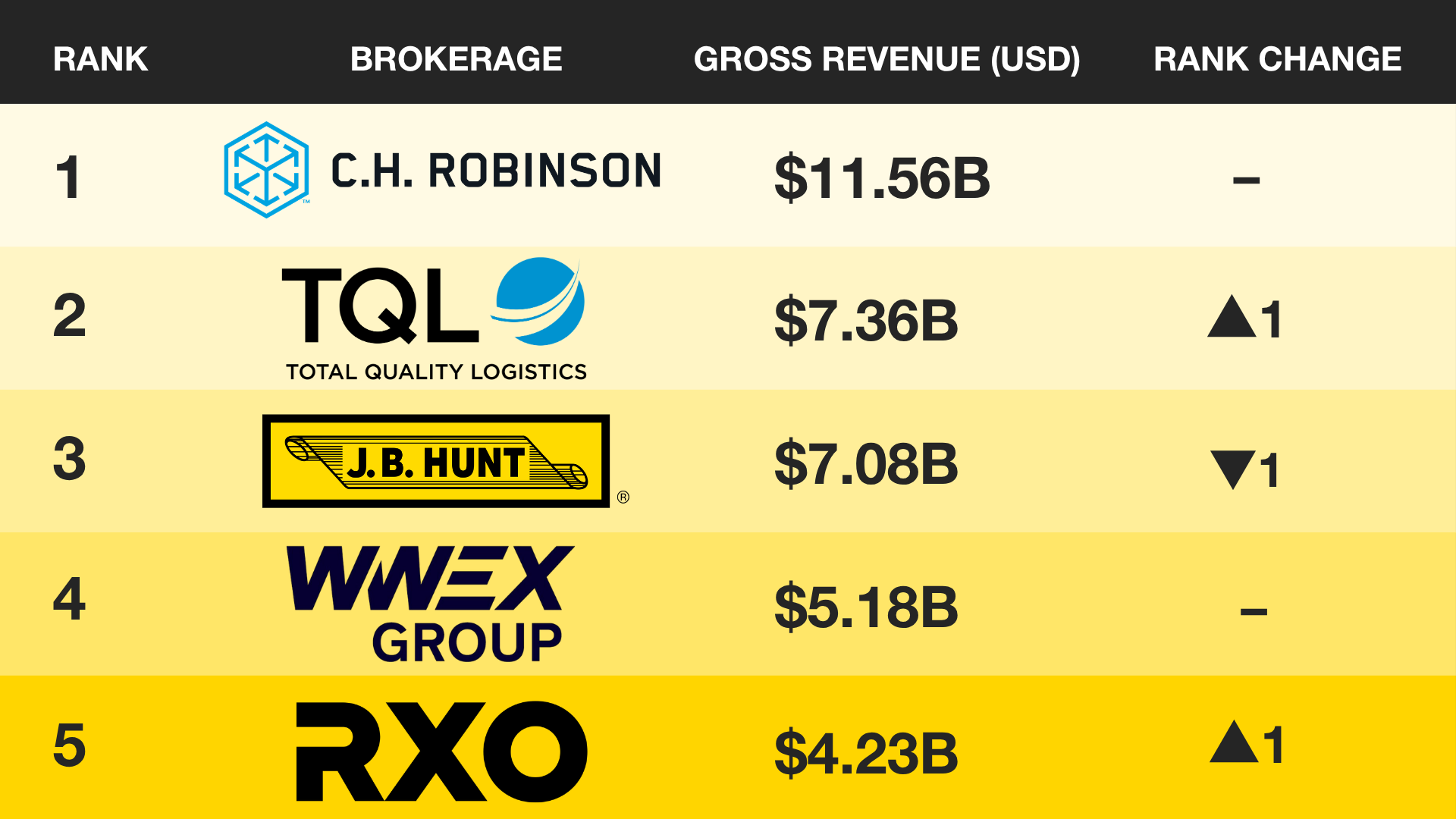
The top five on the pure brokerage list by gross revenue. Also displays rank change from 2025 to 2026 on the Top 100. Source: Transport Topics
Rounding out the Top 10:
Echo Global Logistics – $4B
Arrive Logistics – $2.69B
Landstar System – $2.62B
Schneider – $2.2B
Mode Global – $2.1B
#1: C.H. Robinson
C.H. Robinson holds the #1 spot on the brokerage list, with $11.56 billion in 2025 gross brokerage revenue, down from $11.73 billion in 2024.
On the overall logistics list, the picture is starker: total gross logistics revenue fell 12.3% from an estimated $16.8 billion in 2024 to $14.77 billion in 2025 as Robinson shed headcount and leaned into automation. Net revenue held nearly flat, $2.56 billion in 2025 versus $2.56 billion in 2024, meaning margins actually improved as gross shrank.
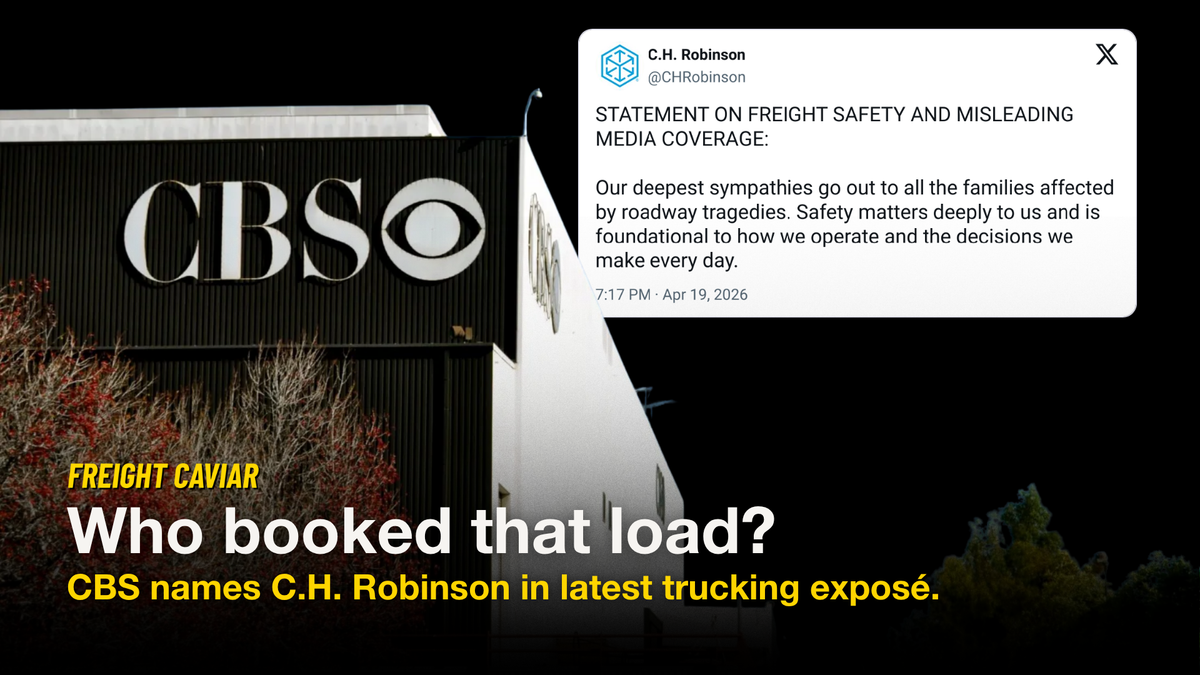
Now that the company has the CBS/60 Minutes chameleon carrier fallout, reputational pressure should be added to the math.
TQL moved from #3 to #2, overtaking J.B. Hunt on the brokerage list.
Gross brokerage revenue grew from $6.82 billion in 2024 to $7.36 billion in 2025 — an 8% gain through one of the hardest freight markets in recent memory.
#3. J.B. Hunt
J.B. Hunt slipped from #2 to #3 on the brokerage list despite holding 2025 gross brokerage revenue nearly flat at $7.08 billion. Hunt didn't lose ground so much as TQL caught up, a reflection of TQL's aggressive growth rather than any Hunt stumble.
Biggest Climbers
A few companies stand out for rank movement:
Armstrong Transport Group jumped from #20 to #13 (+7 spots), with 2025 brokerage revenue up 28.6% from $1.05B in 2024 to $1.35B in 2025. The biggest rank jump in the top 25, largely organic.
Arrive Logistics climbed from #11 to #7 (+4 spots).
ITS Logistics moved from #18 to #16 (+2 spots), with 2025 revenue up 19.3%.
Biggest Drops
Ascent Global Logistics fell from #25 to #32 (-7 spots), the steepest rank drop on the list.
Nolan Transportation Group #16 to #22 (-6 spots).
ArcBest Corp. dropped from #13 to #19 (-6 spots). 2025 revenue declined 10.7% from $1.40B in 2024 to $1.25B in 2025.
Mode Global slid from #8 to #10 (-2 spots). 2025 revenue fell 9.5% from $2.32B in 2024 to $2.1B in 2025.
R&R Family of Cos. ranked #29 on the 2025 list with $858M in 2024 brokerage revenue. Off the list entirely in 2026; the company closed in January 2026 after losing its largest lender.
The rankings reveal who survived the downturn with pricing discipline intact and who bought their way to growth. The brokerages that held pricing discipline and invested in relationships during the soft market are now pulling away from the pack.
If you're a smaller broker competing against TQL or Arrive for the same shipper relationships, the competitive gap just got wider.
"Post and Pray" shouldn't be the only way to find new capacity - now with OTR Select it's never been easier to find reliable capacity and market insights.
Real Capacity: Built on millions of invoice-backed loads from continuously vetted carriers, not self-reported or scraped data.
Real Rates: View legitimate rates based on what carriers are actually accepting, helping you quote faster and protect margin.
The Most Secure Network: Every carrier in the OTR Network is vetted on entry and monitored 24/7/365.
OTR Select is a capacity and rate intelligence platform available to a select group of brokers.
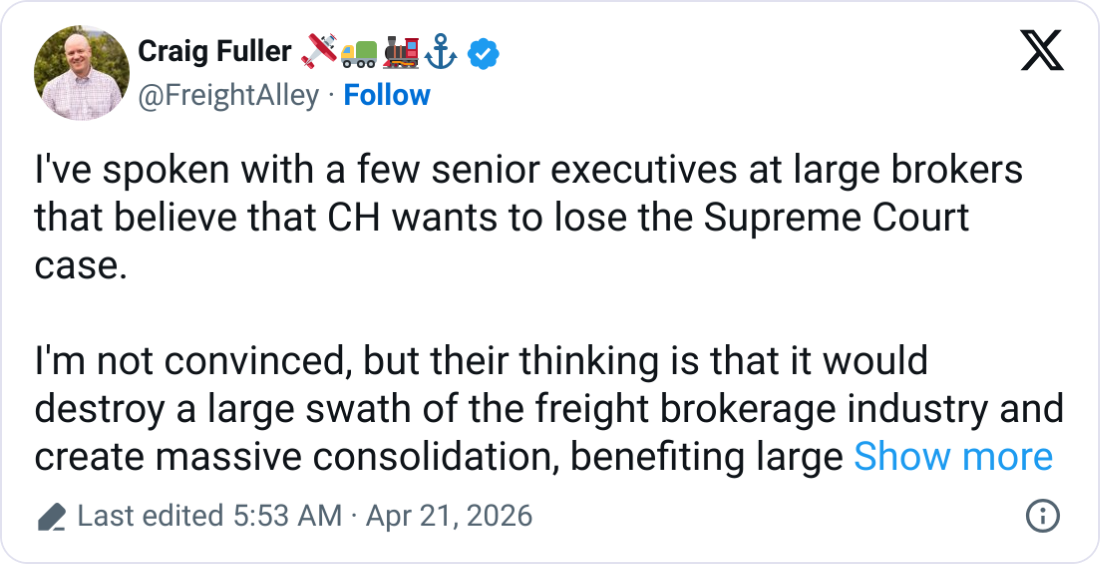
🤔 Craig Fuller Theorizes. Some senior executives at large brokers believe C.H. Robinson actually wants to lose the Supreme Court broker liability case; the theory being a ruling against brokers would devastate smaller operators and consolidate volume toward the giants.
🗽 Elon Musk Weighs In. What started as a niche compliance debate inside trucking just landed in front of Musk's 230 million X followers after he reposted Duffy's statement on New York's non-domiciled compliance strike.
💸 Trump Discourages Refunds. After CBP launched a $166 billion tariff refund portal, Trump told companies on CNBC he would "remember" those who don't file, just a day after the portal went live.
🚛 Ohio Turnpike Rogue Carriers. 315 trucking companies owe $5.2 million in unpaid Ohio Turnpike tolls, the latest data point in a growing picture of carriers operating outside the system.
📦 Saia Expands Northeast. Saia opened a new 74-door terminal in York, PA, strengthening its coverage across the mid-Atlantic and Northeast corridor.
🕵️ Super Ego Lawsuit Details. A class-action lawsuit reveals how Super Ego and eight connected carriers systematically defrauded over 1,000 owner-operators, including altering C.H. Robinson load confirmations to pocket the difference between what brokers paid and what drivers were told.
I’m Adriana, a writer and editor at FreightCaviar. I’ve covered everything from freight tech to industry lawsuits and market shifts, helping scale us to almost 14K subscribers. My goal: to make logistics stories digestible, clear, and fun to read.
66% of logistics pros say talent quality — not cost — is the #1 factor in choosing a nearshore partner. Rapido's integration model explains why that's the right question to be asking.
Plus, a carrier pleading guilty to mob money laundering while still FMCSA-active, Iran's first post-ceasefire attack and what it means for diesel surcharges, FedEx Freight's first earnings as a standalone company, and more in today's newsletter.
Freight brokers are measuring their inboxes wrong. Most inbound email is monitoring, not work. And the longtail categories that look like noise are costing real margin. Here's how to audit what's actually in your inbox, and why it matters in 2026's margin-first market.
Bad carriers are gaming the weigh station system. Plus, C.H. Robinson's own engineer goes scorched earth on Reddit, the Ghost Truck Act gets roasted, and more in today's newsletter.
Keep up with the freight broker world in 5 minutes.
Join over 14K+ subscribers to get the latest freight news and entertainment directly in your inbox for free. Subscribe & be sure to check your inbox to confirm (and your spam folder just in case).