66% of logistics pros say talent quality — not cost — is the #1 factor in choosing a nearshore partner. Rapido's integration model explains why that's the right question to be asking.
Plus, a carrier pleading guilty to mob money laundering while still FMCSA-active, Iran's first post-ceasefire attack and what it means for diesel surcharges, FedEx Freight's first earnings as a standalone company, and more in today's newsletter.
Freight brokers are measuring their inboxes wrong. Most inbound email is monitoring, not work. And the longtail categories that look like noise are costing real margin. Here's how to audit what's actually in your inbox, and why it matters in 2026's margin-first market.
Motor oil shortages are emerging amid supply chain disruptions. Plus: freight prices hit an 8-year high, broker bonds and nuclear verdicts under the microscope, a trucking company pays $5.5M for refusing to hire women, and more.
Happy Monday. Motor oil is facing a shortage caused by supply chain disruptions. We break it down in today's feature.
Plus:
Freight Prices Just Hit an 8-Year High
Brokers: $75,000 bond, $36 million verdicts
Trucking Company Pays $5.5M for Refusing to Hire Women
💡
Question of the Day: The LMI Transportation Prices Index hit 95.0 in April, the highest reading since April ____ and the third-highest since the index launched in 2016.
Today's Newsletter is Brought to You by Epay Manager.
🍳 What's Cookin' In Freight
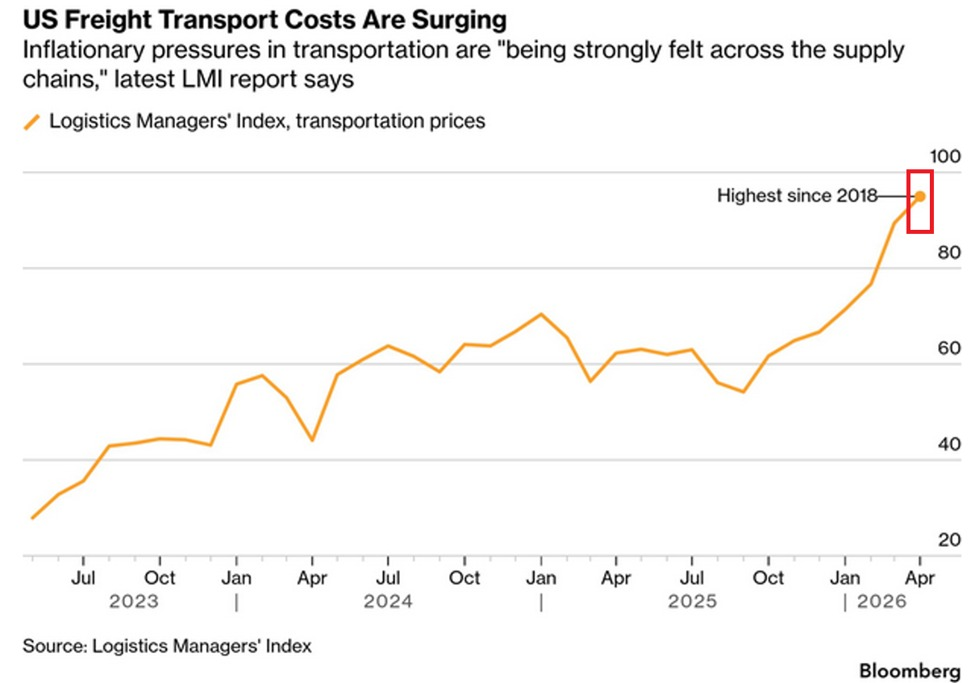
LMI Index shows Transportation Prices skyrocketing. Image Source: Bloomberg via LMI data.
📉 Freight prices just hit an 8-year high. Brokers and carriers have felt the rate surge for weeks. Now it's hitting the data. The LMI Transportation PricesIndex hit 95.0 in April, the highest reading since April 2018 and the third-highest since the index launched in 2016. Producer price indexes for both truckload and LTL jumped roughly 20% year over year in the same month. Flatbed rates hit an all-time high going into Roadcheck week, and tender rejections east of the Rockies are cooking. The capacity that left during the freight recession isn't coming back, and the carriers still standing know it. Contract rates that looked reasonable in Q1 are aging poorly.
⚖️ Brokers: $75,000 bond, $36 million verdicts. The Montgomery conversation has focused on carrier vetting, but the number that actually matters is this: the only federal financial requirement for a freight broker is a $75,000 surety bond. That bond doesn't cover personal injury judgments or tort liability. It exists to ensure carriers are paid when a broker defaults on freight payments. Nothing more. Meanwhile, the median nuclear verdict in trucking cases has hit $36 million and is still climbing. A surety bond got brokers through last week's legal environment. This week, contingent auto liability coverage deserves the same attention.
🚚 Trucking company pays $5.5M for refusing to hire women. The Equal Employment Opportunity Commission (EEOC) sued Warren, Michigan-based Central Transport in March, and the company settled within a month. The charge: systematically refusing to hire qualified female truck drivers for at least a decade across terminals nationwide. Women with 15 and 21 years of experience were passed over while less-qualified male drivers got hired the same week. At a Dunbar, West Virginia, terminal, a dispatcher told a female applicant that corporate had instructed him not to hire women. At a Detroit terminal, employees were seen retrieving a woman's application from the trash when she returned to make corrections — her male cousin, who had applied alongside her, had been hired.
Your inbox wasn’t built for invoicing. Epay Manager was.
For decades, Epay has delivered back-office automation for freight brokers that is fundamentally different: it delivers a proactive invoicing workflow by building the carrier invoice from data in your TMS and proactively collecting invoice documents in-platform.
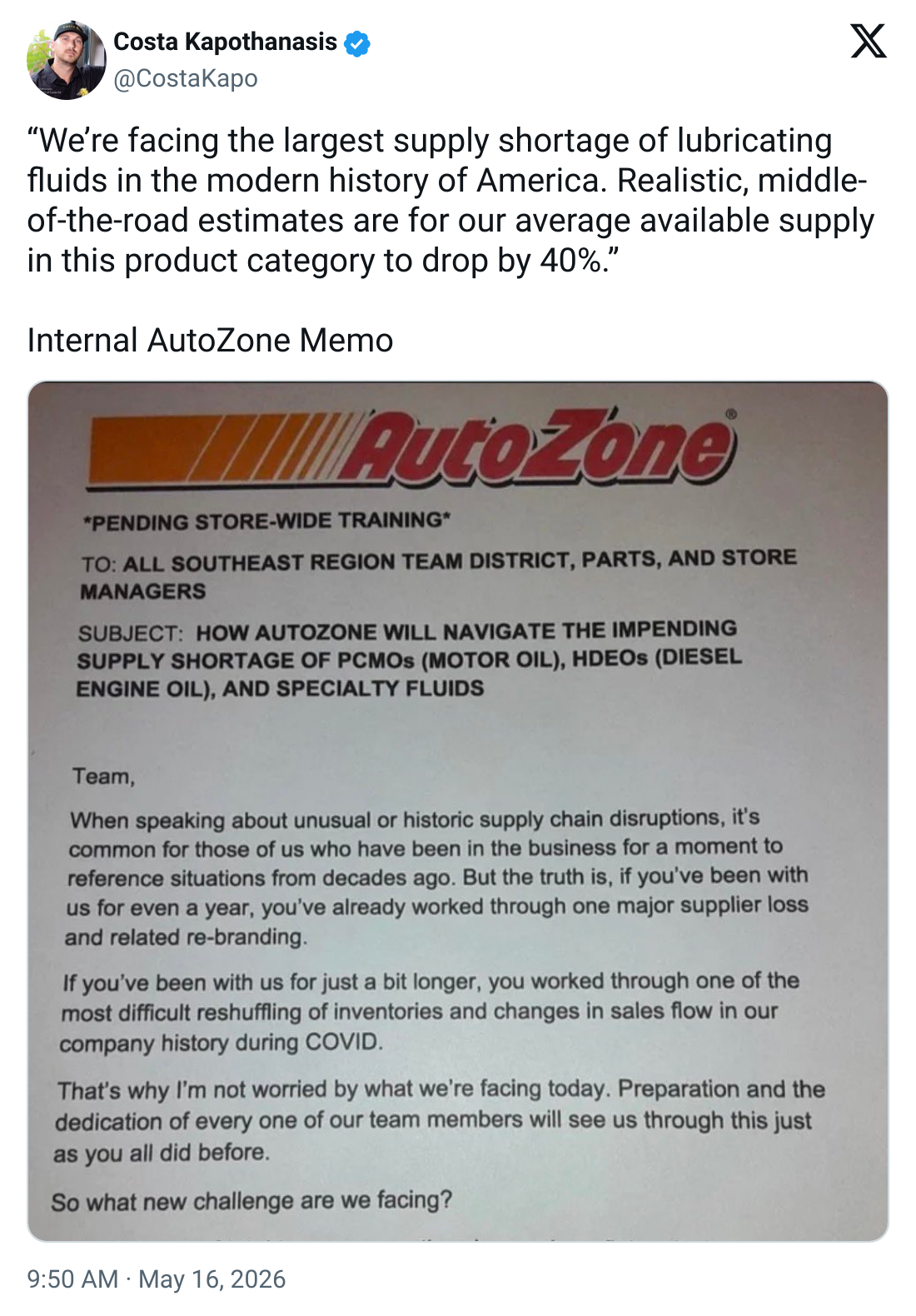
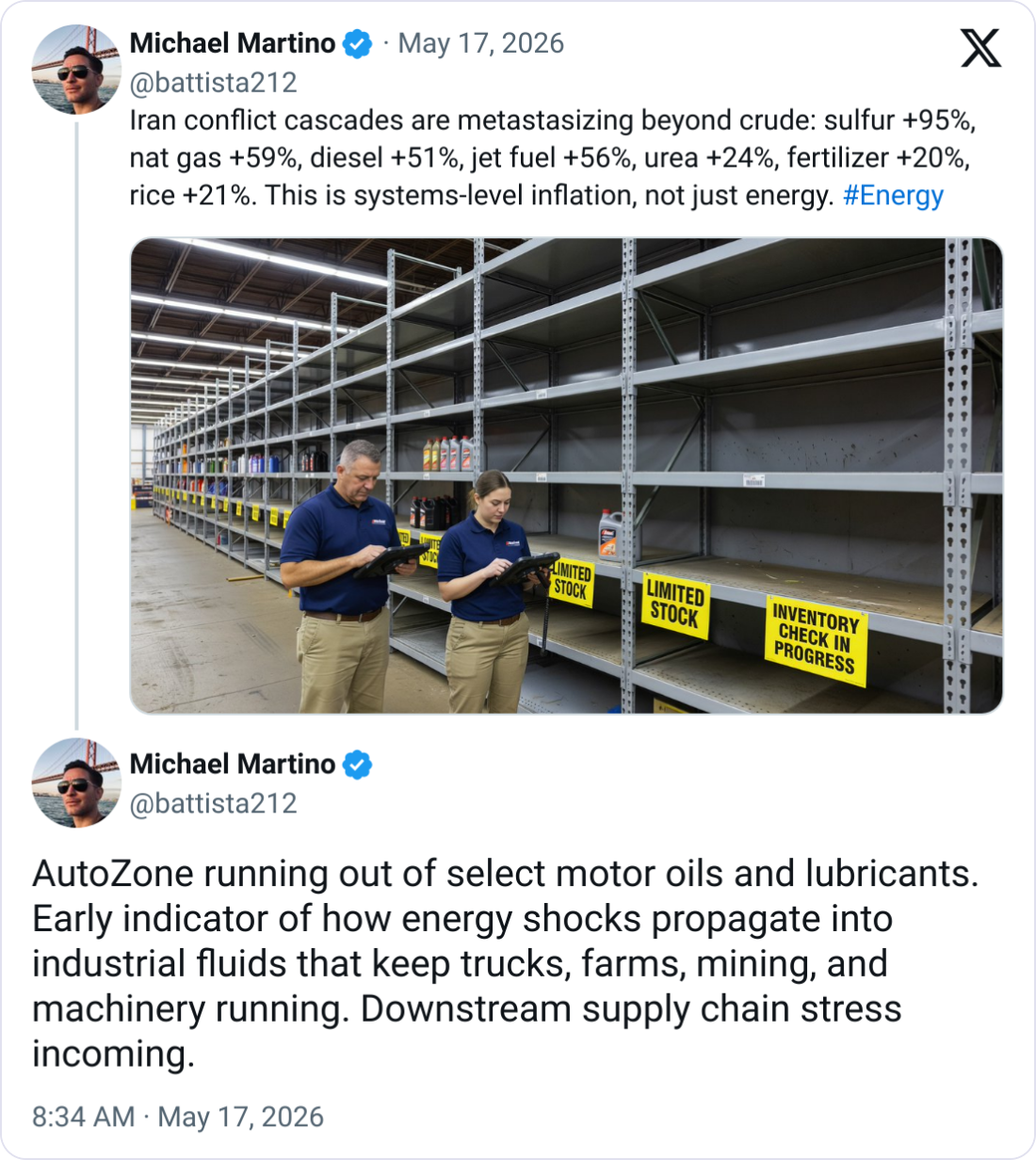
Flatbed rates are at multi-year highs, tender rejections are scorching east of the Rockies, and now a quiet supply crisis is slamming the one consumable every fleet, dealer, and owner-operator buys without a second thought: motor oil and lubricants.
The core issue is Group III base oil. The highly refined feedstock that underpins nearly all modern synthetic and semi-synthetic engine oils, plus a growing share of heavy-duty formulations, transmission fluids, and hydraulic oils. When Group III tightens, the pain spreads fast across the entire finished lubricant chain.
Industry sources report roughly 40-44% of U.S. Group III supply is under severe pressure or offline, driven by Middle East disruptions (refinery outages in the Gulf, the Strait of Hormuz effectively closed to normal traffic). There are some reports of Group III base oil exceeding $10/gallon. Analysts don’t expect normalization until mid-2027.
The Trucking Angle
Heavy-duty engines increasingly spec synthetic or synthetic-blend oils for extended drains, fuel economy, and emissions compliance. A prolonged squeeze means:
Higher costs. Expect 10-30%+ jumps on synthetics and synthetics blends.
Availability risk. Deferred PMs, rationing at distributors, or “operational stress” levels by June/July per industry alerts.
Ripple effects. Transmission fluids, hydraulic oils, and greases also rely on tight base stocks. Warranty headaches if fleets can’t meet OEM specs.
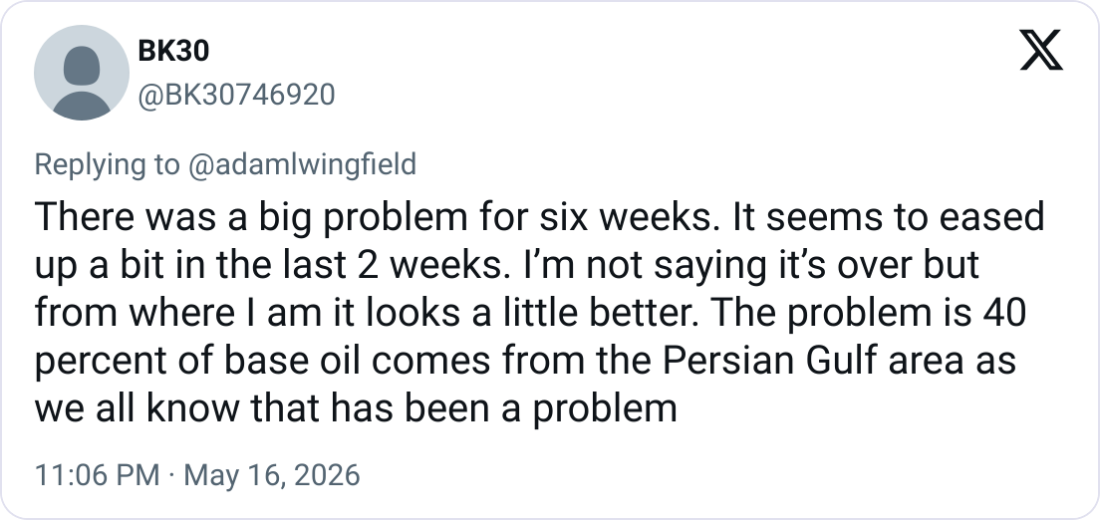
BK30 on X repliedto Adam Wingfield's tweet on the matter, saying this had been a big problem for 6 weeks but had eased a bit in the last 2 weeks.
The Geopolitical Root
Earlier today, IEAhead Fatih Birol warned that global commercial oil inventories are depleting rapidly due to the war in Iran and the closure of the Strait of Hormuz, and that they have only weeks left.
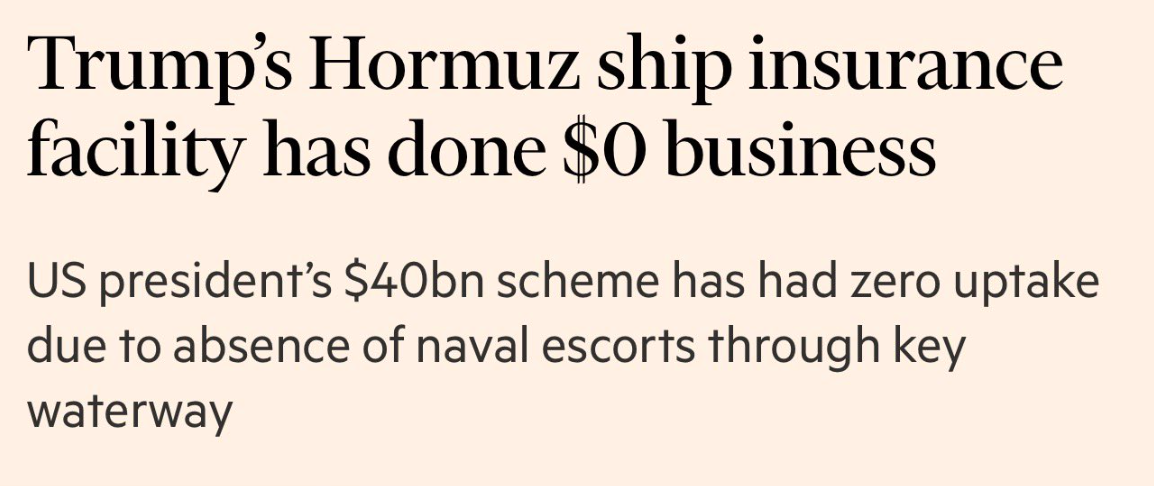
A U.S. shipping insurance program to encourage traffic has seen zero payouts so far. The lubricant chain has minimal buffer left after years of just-in-time inventory.
This doesn’t have the sexy headlines of autonomous trucks or tariffs, but it runs through the veins of every diesel on the road.
🚨 $7M theft ring busted. A Florida-based cargo theft ring was accused of moving $7 million in stolen goods across multiple states.
🌎 $84 billion crossed the US-Mexico border in March alone. Cross-border trade hit $84B in March as USMCA renegotiation talks heat up. Mexican exports to the US are up roughly 15% in recent months.
💸 Scammers are charging for free government services. Lawmakers introduced a bill targeting fraudsters who charge truck drivers for free FMCSA and USDOT services. Drivers are being billed for registrations, updates, and filings that cost nothing through official government channels.
🔧 Deferred maintenance is coming due. Trucks that skipped the shop to survive the freight recession are now running hard in the strongest rate environment in years. FreightWaves flagsa massive accumulation of deferred maintenance across the industry and post-Roadcheck, with OOS rates running nearly double last year's benchmark.
🚛 DOL targets foreign CDL driver English proficiency. The Department of Labor is cracking down on English-proficiency standards for employers hiring foreign commercial-vehicle drivers. It's not just a driver compliance issue anymore; carriers who hired around the requirement are now in the crosshairs, too.
Plus, a carrier pleading guilty to mob money laundering while still FMCSA-active, Iran's first post-ceasefire attack and what it means for diesel surcharges, FedEx Freight's first earnings as a standalone company, and more in today's newsletter.
Bad carriers are gaming the weigh station system. Plus, C.H. Robinson's own engineer goes scorched earth on Reddit, the Ghost Truck Act gets roasted, and more in today's newsletter.
Keep up with the freight broker world in 5 minutes.
Join over 14K+ subscribers to get the latest freight news and entertainment directly in your inbox for free. Subscribe & be sure to check your inbox to confirm (and your spam folder just in case).