66% of logistics pros say talent quality — not cost — is the #1 factor in choosing a nearshore partner. Rapido's integration model explains why that's the right question to be asking.
Plus, a carrier pleading guilty to mob money laundering while still FMCSA-active, Iran's first post-ceasefire attack and what it means for diesel surcharges, FedEx Freight's first earnings as a standalone company, and more in today's newsletter.
Freight brokers are measuring their inboxes wrong. Most inbound email is monitoring, not work. And the longtail categories that look like noise are costing real margin. Here's how to audit what's actually in your inbox, and why it matters in 2026's margin-first market.
Happy Monday. New LTL classification rules are here. We break down what changed, how top LTL carriers are responding, and what it means for your margins this week.
Plus,
📊 Triumph Q2 Earnings & Next Moves
🍅 U.S. Hits Mexican Tomatoes, Airlines
⚡ Daimler Shifts EV Focus to Europe Amid U.S. Policy Fog
... and more.
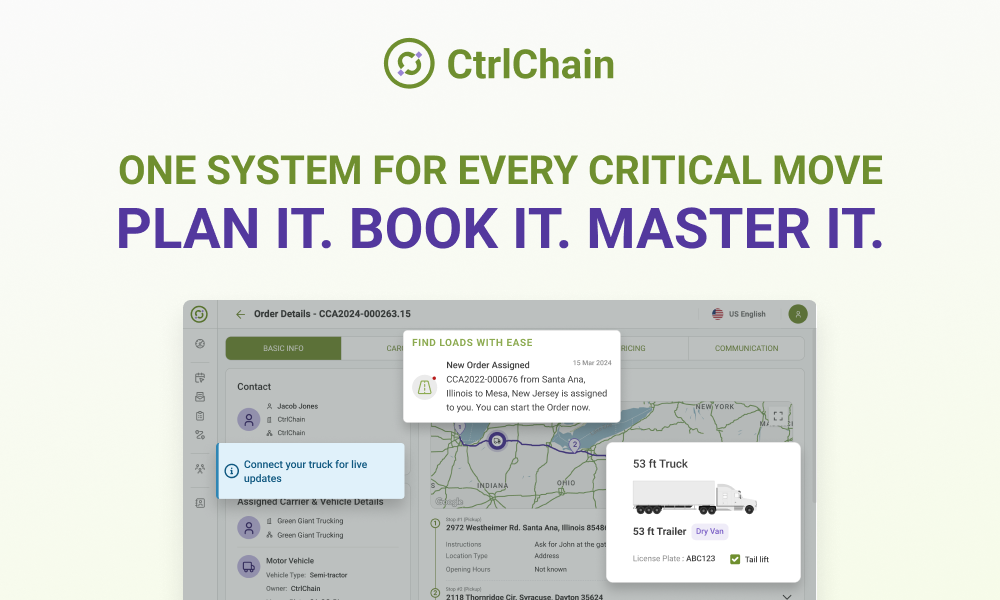
Today's Newsletter is Brought to You by CtrlChain.
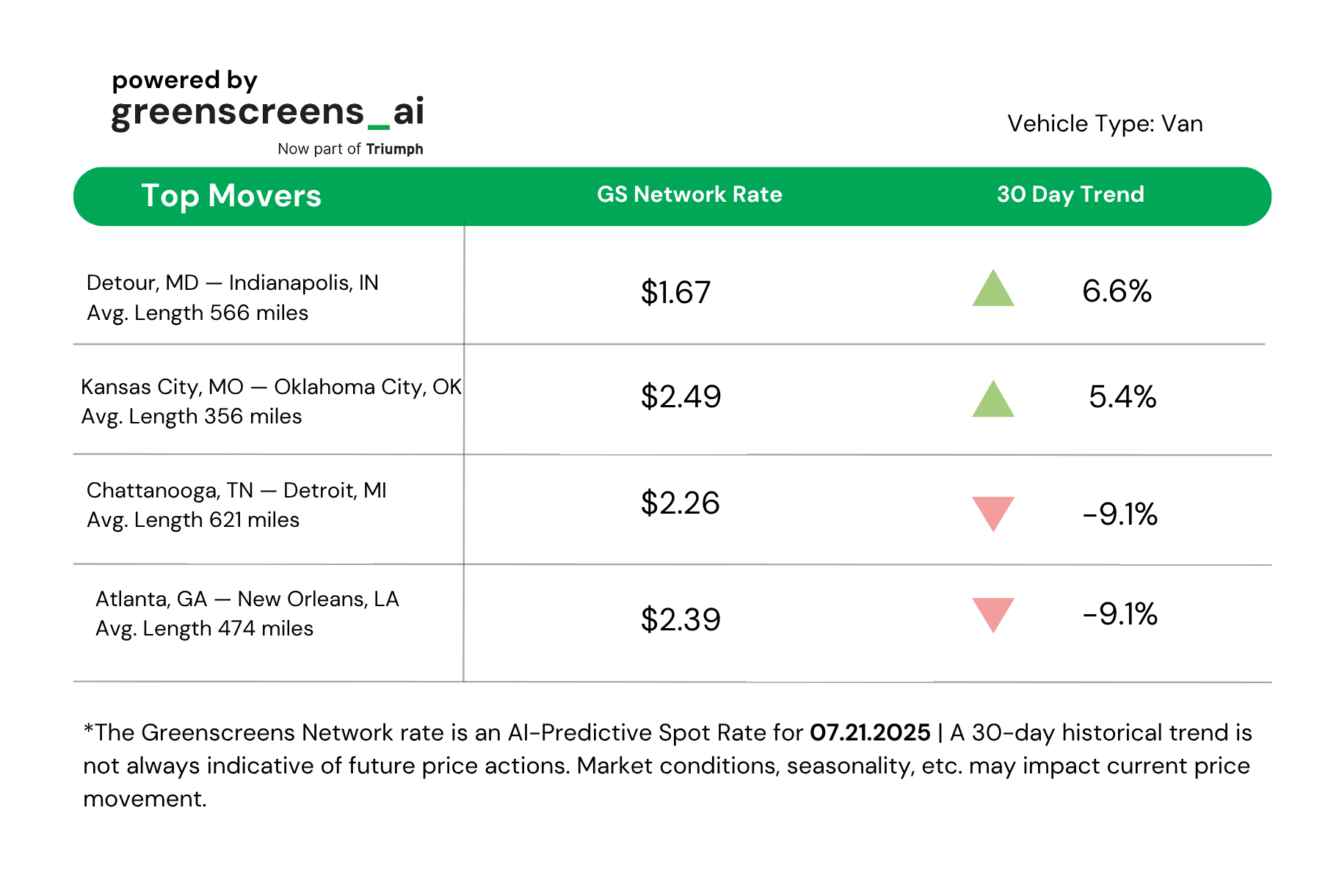
Greenscreens.ai forecasts truckload buy prices tailored to each brokerage using AI and 130+ data points.
🍳 WHAT’S COOKIN’ IN FREIGHT
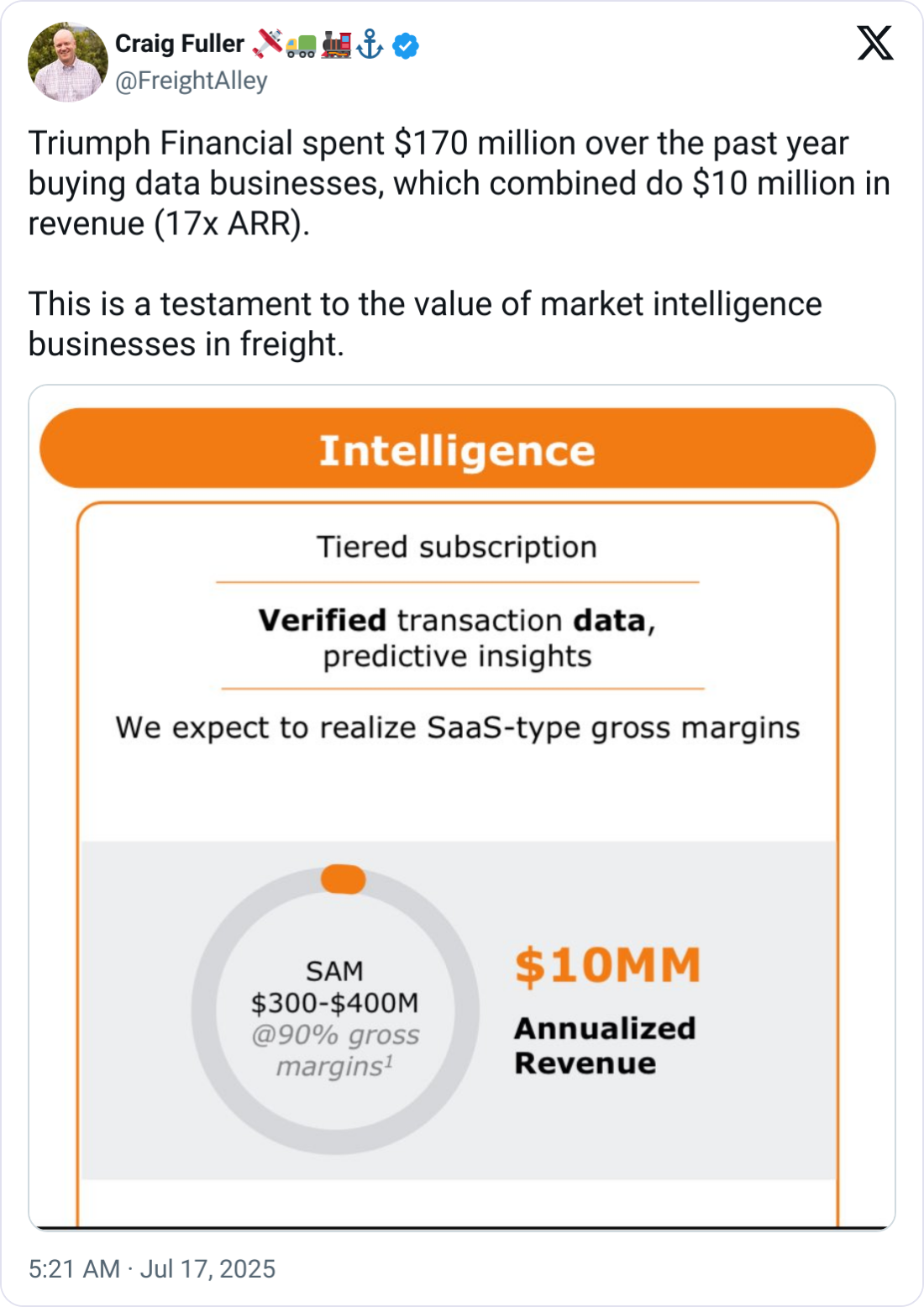
📊 Triumph Financial Settles USPS Dispute, Doubles Down on Freight Intelligence. Triumph Financial’s Q2 earnings report signals a strategic pivot beyond traditional factoring. The company posted $12.4 million in net income, largely due to resolving a $19.4 million dispute with the U.S. Postal Service tied to its 2020 acquisition of Covenant Logistics’ factoring business. While freight market conditions remain soft, Triumph processed 1.7 million invoices totaling $2.87 billion, up 13.3% from Q1, but average invoice size declined. Triumph also consolidated Greenscreens.ai and Isometric Technologies into a new Intelligence division, which it sees as key to reshaping broker-carrier operations through routing data, audit tools, and integrated digital payments via LoadPay.
🍅 Washington Targets Mexican Tomatoes and Airlines, Why It Matters For Cross-Border Industry. The U.S. has ended the 2019 Tomato Suspension Agreement, slapping a 17% duty on Mexican tomato imports, worth $3.12 billion in 2024 and nearly 70% of the U.S. market. At the same time, the DOT is revoking Delta-Aeromexico antitrust immunity over Mexico’s cargo relocation mandate. Logistics professionals now face dual pressures: higher produce costs and increased air cargo complexity. Border Trade Alliance warns of “lasting damage” to trade and jobs. Key crossings like Laredo and Nogales will feel the strain. Shippers must reassess sourcing and routing strategies as tariffs and aviation restrictions take effect in the coming months.
⚡ Daimler Shifts Electric Truck Focus to Europe Due To U.S. Policy Uncertainty. Daimler Truck AG is scaling back its North American EV ambitions and prioritizing Europe, citing clearer regulatory support and infrastructure readiness. The company plans to sell 25,000 electric trucks annually in Europe by 2030, fueled by its eActros 600. In contrast, Daimler criticized the U.S. for inconsistent policies, paused EPA waivers, and ACT rule confusion, prompting a halt in Oregon sales. While cutting 5,000 jobs in Germany, Daimler remains committed to the EU’s coordinated green transition. U.S. market unpredictability, executives say, makes long-term EV planning untenable despite growing global demand for zero-emission freight.
"If you ship LTL Freight and rely on a similar sticky note, you need to rethink your plan—your item numbers may be changing..." Image Source: NMFTA
As of Saturday, July 19, the National Motor Freight Classification (NMFC) system dropped its decades-old, commodity-based pricing model in favor of a streamlined density-first framework.
This is not a small change. It's a seismic redefinition of how LTL freight is classified and billed.
“This docket is really the largest we’ve ever put out,” saidKeith Peterson, Director of Operations at the NMFTA. “It had 99 proposals… affecting over 2,000 items. It was a huge one.”
Let’s break down what’s changing, what it means for your ops, and who’s best positioned to weather the shake-up.
What Changed?
Freight class is now all about size. Low-density pallets that once got a deal could now cost more, while dense shipments may get a break. It’s all about how much space your freight eats up on the truck.
Out with the Old: More than 2,000 specific item classifications have been eliminated or consolidated.
In with Density: Freight will now be primarily classified by density, not commodity.
API-Ready: NMFTA launched digital tools like ClassIT+ and GetClassification.com to help shippers, carriers, and 3PLs stay up to date.
Education Push: No penalties (yet) for using outdated classifications, but disputes and rebills will be a reality if adaptation doesn't happen fast..
For many brokers and shippers, chaos is the word. If your client’s freight is suddenly being billed at a higher class, you may already be fielding angry emails.
Expect:
A spike in reclassification disputes
Carrier reps leveraging the new system to push through higher rates
Operational teams scrambling to recalculate margins mid-load
For those who’ve prepped, updating item numbers, retraining staff, and leveraging NMFTA’s APIs, this is a moment to shine.
Rates Are Already Climbing
Even before the NMFC change hit, LTL pricing was trending up:
The TD Cowen/AFS LTL index is forecast to hit a record high in Q3, 66% above 2018 levels.
Carriers are showing rate discipline and tighter revenue management even as volumes wobble.
The new NMFC framework gives carriers another tool to justify pricing shifts.
“The NMFC transition to a density framework should equip carriers with another method to tightly manage freight classification and pricing,” said Aaron LaGanke, VP of Freight Services at AFS.
Meanwhile, weight per shipment is down and rebills are expected to spike. It’s a classic “less for more” scenario if shippers aren’t paying attention.
This rule change is happening during a time of clear divergence in freight markets.
LTL carriers are flexing pricing power, while TL fleets continue to feel recession pressure. According to our recent breakdown of the Top 100 For-Hire Carriers, LTL giants are holding ground, and in some cases, growing:
XPO, Estes Express, and Old Dominion all outperformed or maintained their ranks.
TL-heavy carriers like Schneider and TFI International slipped, citing weak volumes and poor margins.
FedEx is even prepping to spin off its LTL unit, betting that the segment can perform independently.
LTL is becoming a cornerstone of margin management in a volatile market. And the NMFC overhaul just raised the stakes.
Your team’s drowning in busywork. Appointment confirms. PODs. Capacity calls. HappyRobot gives you AI workers that handle it all — in parallel, at scale, 24/7. What used to take a month? Now it takes an hour.
No more bottlenecks. No more burnout. Just fast, flawless execution.
⚖️ Broker Legal Uncertainty. A FreightWaves op-ed calls on the Supreme Court to resolve conflicting lower court rulings that threaten the legal protections of freight brokers under federal preemption laws.
🚢 Oakland Volumes Fall. Port of Oakland container shipments fell 10.1% in June year-over-year, as weakened export demand and shifting trade flows continue to affect West Coast port activity.
🧾 FDA Tightens Import Scrutiny. All FDA-regulated goods entering under the de minimis threshold now face agency review, increasing oversight of small-value imports and tightening controls on food, drug, and cosmetic shipments.
📦 UPS Buyouts Coming. UPS is preparing to begin buyout offers to drivers, with voluntary separations expected to start by August 31. The move aims to cut labor costs amid shifting parcel volumes.
🚨 Fatal Oversized Load Crash. A truck driver hauling an oversized load died after crashing into the Ohio River. Authorities are investigating whether routing or equipment contributed to the fatal incident.
⚖️ Crane Hauler Acquitted. A truck driver was found not guilty in a fatal crash involving an improperly permitted crane load that killed a motorcyclist. This ruling now raises questions about enforcement and liability in oversized freight operations.
🎣 THE FREIGHT CAVIAR CORNER
FreightCaviar Podcast: Last week, we sat down with Omer Ramusevic, founder of My Staffing Partner, to talk about Bosnia’s rise in logistics outsourcing, mindset gaps between U.S. and Balkan teams, and more. Catch it on YouTube, Spotify, or Apple Podcasts.
Manifest 2026: FreightCaviar community, tap into massive savings on Manifest 2026. Get registered now and save $1100 on your attendance price. Click here for the deal.
FreightJobs.co: HaulPay is looking for a remote Business Development Specialist. You can apply directly from our freight job board.
Freight Broker Group Chat: Lost a load to a ghost MC? Just discovered a 15-layer carrier spoof ring? Come swap war stories, drop memes, and ask the stuff no one wants to post on LinkedIn. Join us on forum.freightcaviar.com
I’m Adriana, a writer and editor at FreightCaviar. I’ve covered everything from freight tech to industry lawsuits and market shifts, helping scale us to almost 14K subscribers. My goal: to make logistics stories digestible, clear, and fun to read.
Hello! I'm Jerome FreightCaviar! I’m into the politics of freight and the impact it will have worldwide. I'm always eager to learn more. Follow me on X @JeromeFreightC
Plus, a carrier pleading guilty to mob money laundering while still FMCSA-active, Iran's first post-ceasefire attack and what it means for diesel surcharges, FedEx Freight's first earnings as a standalone company, and more in today's newsletter.
Bad carriers are gaming the weigh station system. Plus, C.H. Robinson's own engineer goes scorched earth on Reddit, the Ghost Truck Act gets roasted, and more in today's newsletter.
Keep up with the freight broker world in 5 minutes.
Join over 14K+ subscribers to get the latest freight news and entertainment directly in your inbox for free. Subscribe & be sure to check your inbox to confirm (and your spam folder just in case).