66% of logistics pros say talent quality — not cost — is the #1 factor in choosing a nearshore partner. Rapido's integration model explains why that's the right question to be asking.
Plus, a carrier pleading guilty to mob money laundering while still FMCSA-active, Iran's first post-ceasefire attack and what it means for diesel surcharges, FedEx Freight's first earnings as a standalone company, and more in today's newsletter.
Freight brokers are measuring their inboxes wrong. Most inbound email is monitoring, not work. And the longtail categories that look like noise are costing real margin. Here's how to audit what's actually in your inbox, and why it matters in 2026's margin-first market.
The U.S. Department of Transportation is sharpening its focus on English-language proficiency requirements for truck drivers, pointing to two fatal crashes as evidence that insufficient English skills can endanger public safety. The push comes after President Trump’s April 28 executive order that rescinded a 2016 policy which had relaxed enforcement of long-standing federal rules on English use by commercial vehicle operators.
High-Profile Crashes Spotlighted
USDOT Secretary Sean Duffy spoke on the urgency of the legislation, stating:
“FMCSA has documented cases where drivers’ inability to read our signs and speak our language may have contributed to a series of fatal accidents.”
Cuban-born driver Rogel Aguilera-Mederos was traveling nearly 85 mph in a truck-restricted zone when he lost brake control, bypassed a runaway ramp, and caused a massive pileup. The crash killed four people and involved 28 vehicles. Aguilera-Mederos, who required a translator during legal proceedings, initially received a 110-year prison sentence, later reduced to 10 years after public outcry.
2025 West Virginia Cheat Lake Bridge Crash: New York-based driver Sukhjinder Singh jackknifed on an icy bridge, causing the death of Pennsylvania resident Kevin C. Lataille when his vehicle was forced into the lake below. Singh had struck another car before the bridge and was arrested on negligent homicide charges. Police confirmed Singh used a translator during post-crash investigations, though it remains unclear how language barriers directly contributed to the crash.
Policy and Enforcement
Federal law requires commercial drivers to be able to read and speak English well enough to understand road signs and interact with law enforcement. Duffy emphasized:
“Federal law is clear, a driver who cannot sufficiently read or speak English—our national language—and understand road signs is unqualified to drive a commercial motor vehicle in America. This commonsense standard should have never been abandoned.”
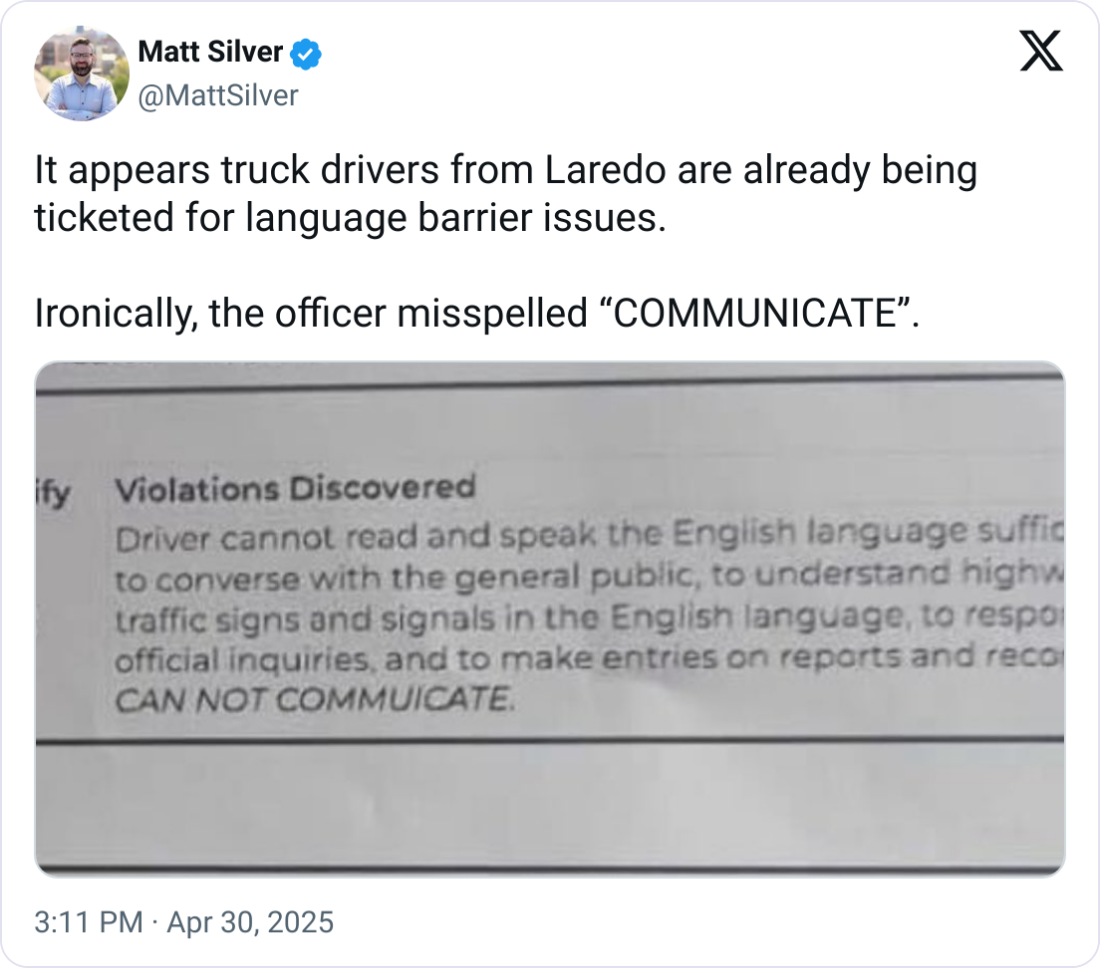
So, while English proficiency will be a key focus moving forward, will it fully enforced, because as Matt Silver reported on his X, a driver was given a ticket (and not put out-of-service) for not speaking English sufficiently.
Hello! I'm Jerome FreightCaviar! I’m into the politics of freight and the impact it will have worldwide. I'm always eager to learn more. Follow me on X @JeromeFreightC
Plus, New York takes the CDL fight to federal court, a new wave of carrier and broker bankruptcies, cargo thieves are infiltrating vetted fleets from the inside — and more in today's newsletter.
Plus, USPS gives non-domiciled CDL carriers an 11-day deadline, the spot-to-contract spread starts squeezing 3PLs, Knight-Swift trims its Q1 guide but stays bullish, and more.
Plus, diesel's rising price streak finally snaps, a 13-year shipper relationship ends in a $726K lawsuit, Congress takes a real swing at cargo theft, and more in today's newsletter.
Keep up with the freight broker world in 5 minutes.
Join over 14K+ subscribers to get the latest freight news and entertainment directly in your inbox for free. Subscribe & be sure to check your inbox to confirm (and your spam folder just in case).