66% of logistics pros say talent quality — not cost — is the #1 factor in choosing a nearshore partner. Rapido's integration model explains why that's the right question to be asking.
Plus, a carrier pleading guilty to mob money laundering while still FMCSA-active, Iran's first post-ceasefire attack and what it means for diesel surcharges, FedEx Freight's first earnings as a standalone company, and more in today's newsletter.
Freight brokers are measuring their inboxes wrong. Most inbound email is monitoring, not work. And the longtail categories that look like noise are costing real margin. Here's how to audit what's actually in your inbox, and why it matters in 2026's margin-first market.
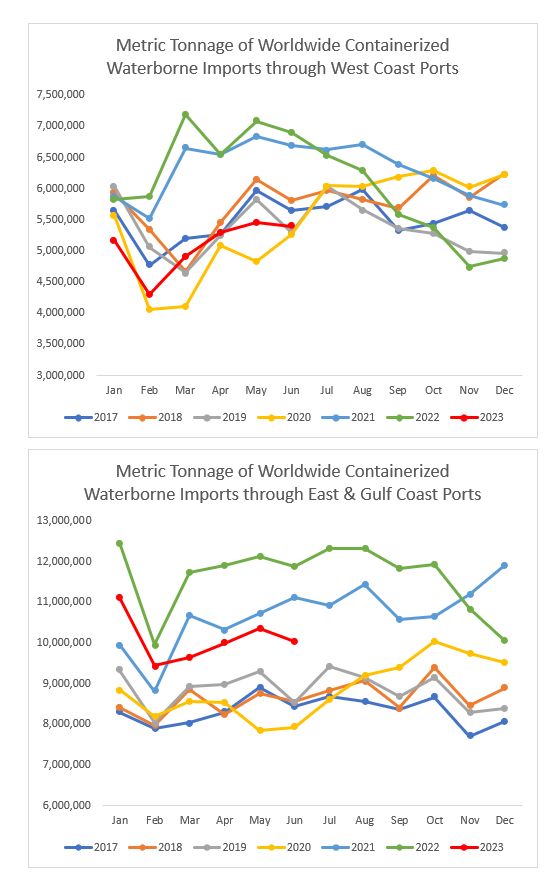
Recent data and industry observations suggest a significant shift in containerized imports in the US, marking a movement away from the West Coast ports in favor of the East and Gulf Coast counterparts. Jason Miller's analysis on LinkedIn reveals a notable decrease in imports through the West Coast ports, with metrics highlighting:
West Coast: June 2023 imports were down 22% from June 2022, and settling around 2019 levels.
East and Gulf Coasts: In contrast, June 2023 recorded a 17% rise from June 2018 and 2019 levels.
This trend, Miller pinpoints, stems from importers investing heavily in transloading facilities and distribution centers near the East and Gulf Coast ports and the shifting import volumes from China towards South Asia.
Source: Jason Miller, LinkedIn
Lazar Gacevski's response to Miller's insights further underscores this shift. He attributes it to factors like the West Coast's diminished capacity, higher operational costs, and the geographical distance from the main body of consumers in the Midwest and East.
Validating these observations, the Port of New York and New Jersey recently celebrated a peak, processing an impressive 725,479 TEUs in July - its highest since October 2022. A sharp contrast is seen with the Port of Los Angeles, which witnessed a 26% drop in TEUs processed YoY in July.
The strength of trade at the East and Gulf Coast ports continues unabated through the Panama Canal, despite current congestions. The canal remains the favored route for container carriers, even with conservation measures that elongate wait times. Roughly:
40% of all US container traffic navigates the canal annually.
$270 billion worth of cargo passes through, emphasizing its critical role in US trade.
Finally! New York/New Jersey was the #1 volume port in July for the first time in forever. Exporters/Importers avoided the West Coast because of this labor issue. Good news is that the East Coast union, the ILA, has a contract up for renewal in 2024 https://t.co/o2S3TbEWWs
I’m Adriana, a writer and editor at FreightCaviar. I’ve covered everything from freight tech to industry lawsuits and market shifts, helping scale us to almost 14K subscribers. My goal: to make logistics stories digestible, clear, and fun to read.
Keep up with the freight broker world in 5 minutes.
Join over 14K+ subscribers to get the latest freight news and entertainment directly in your inbox for free. Subscribe & be sure to check your inbox to confirm (and your spam folder just in case).