66% of logistics pros say talent quality — not cost — is the #1 factor in choosing a nearshore partner. Rapido's integration model explains why that's the right question to be asking.
Plus, a carrier pleading guilty to mob money laundering while still FMCSA-active, Iran's first post-ceasefire attack and what it means for diesel surcharges, FedEx Freight's first earnings as a standalone company, and more in today's newsletter.
Freight brokers are measuring their inboxes wrong. Most inbound email is monitoring, not work. And the longtail categories that look like noise are costing real margin. Here's how to audit what's actually in your inbox, and why it matters in 2026's margin-first market.
In freight brokerage, relationships are everything. Ask almost any broker what separates the firms that last from the ones that fade, and you’ll hear the same answers: customer service, trust, long-term partnerships.
But while most of the industry focuses on the front end of those relationships, like sales calls, check-ins, and rate negotiations, the moment that often defines whether the trust holds or breaks comes later.
After the freight moves. After the POD is submitted. After the work is supposedly “done.”
That’s when accounting teams step in.
Carrier payments, paperwork accuracy, dispute resolutions, and fraud checks – these back-end processes are typically the final interaction a carrier or customer has with a brokerage on a load. And in many cases, they’re the difference between confidence and frustration, loyalty and churn.
What Brokers Say Sets Successful Firms Apart
When brokers talk about success, they don’t point first to technology stacks or financial engineering. They point to people.
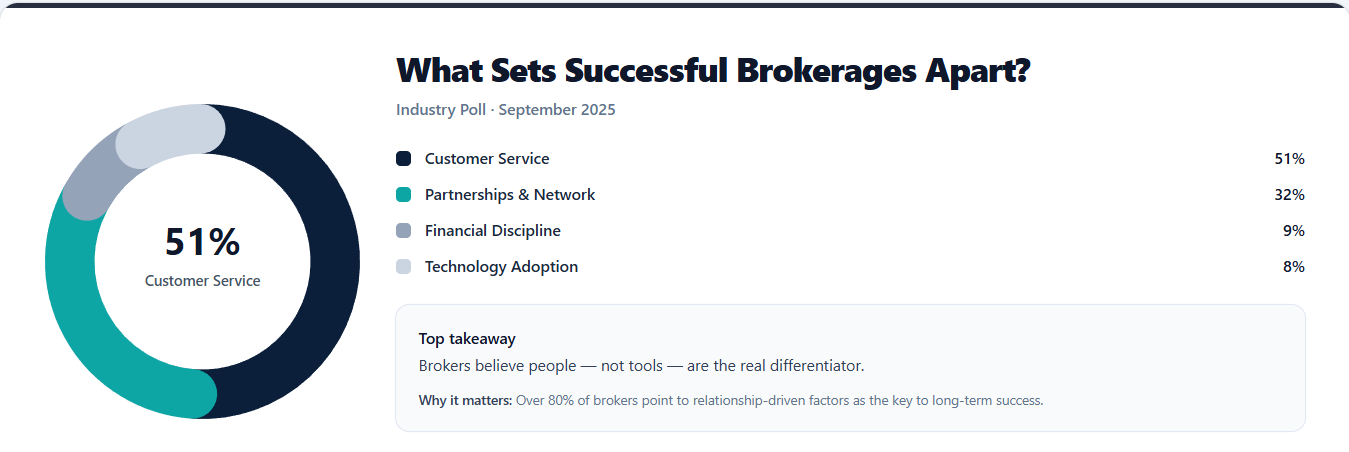
In a September 2025 FreightCaviar poll, more than half of the brokers surveyed said customer service is what sets successful brokerages apart.
Another 32% pointed to partnerships and network strength. Technology adoption and financial discipline, often framed as competitive advantages, trailed far behind.
This shows that brokers overwhelmingly believe success is driven by human trust, not just transactional efficiency. Relationships, responsiveness, and reliability are seen as the real differentiators in a crowded, margin-sensitive market.
But that belief raises an important question: If relationships are what matter most, where are they most vulnerable?
The Post-Delivery Risk
For all the attention paid to booking and execution, the post-delivery phase is where trust is most easily tested and most often overlooked.
This is the moment when:
Carriers are waiting to be paid
Customers expect clean documentation
Disputes surface
Fraud risk peaks
Silence or slow responses create anxiety
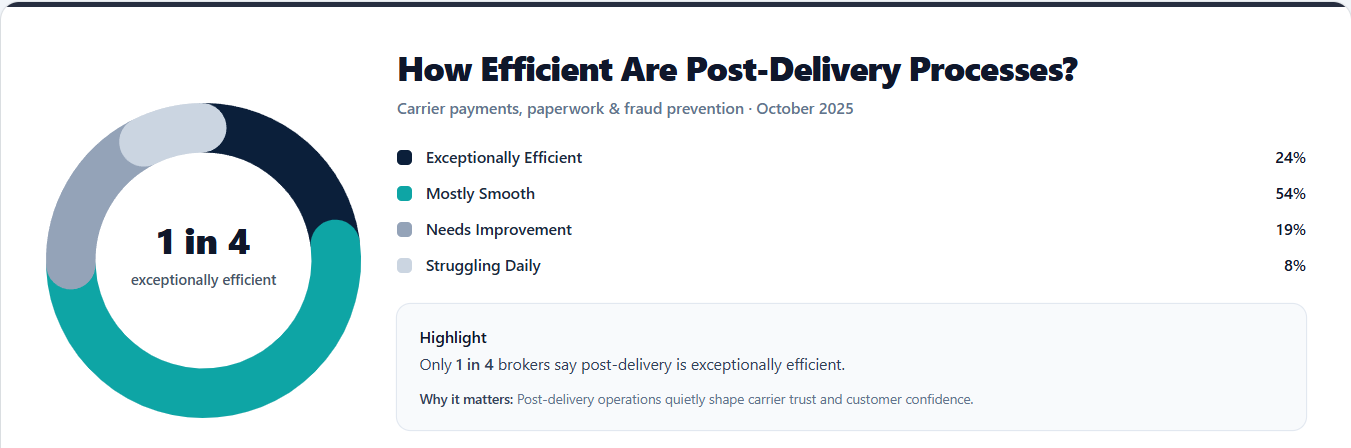
Another FreightCaviar poll from October 2025 highlights the gap. Only 24% of brokers said their post-delivery processes are exceptionally efficient.
More than a quarter admitted those workflows either struggle daily or need improvement. Even among the majority who described their processes as “mostly smooth,” friction still exists.
And “mostly smooth” doesn’t always feel smooth to the people on the other side.
A delayed payment, a missing document, or a vague status update forces carriers and customers to question whether they can rely on the brokerage when things aren’t perfect.
The Accounting Team Is a Trust Engine
Accounting teams are often described as back-office support. In reality, they operate much closer to the center of the brokerage’s reputation.
They are the team that:
Confirms whether carriers get paid when promised
Resolves disputes without escalation
Catches inconsistencies before they turn into accusations
Communicates clearly when timelines change
In many cases, accounting becomes the last human touchpoint in the load lifecycle. That final interaction is what carriers and customers remember, especially when something goes wrong.
Strong accounting teams reinforce trust.
Speed and Accuracy Are Relationship Decisions
It’s easy to frame speed and accuracy as internal metrics, just KPIs tracked on dashboards, targets set for operational efficiency.
But externally, those same metrics feel very different.
Speed signals respect
Accuracy signals credibility
Transparency signals trust
Every delay or unclear response shifts the burden outward. Instead of confidence, carriers and customers are left chasing updates, sending follow-ups, or questioning whether something is being missed.
Over time, those small moments add up because they begin to form a pattern.
Why “Mostly Smooth” Ops Isn’t Enough Anymore
Freight has become less forgiving.
Margins are tighter. Fraud attempts are more sophisticated. Customers expect faster answers with fewer handoffs.
In that environment, post-delivery operations need to be predictable, visible, and consistent.
This is where platforms like Epay Manager increasingly play a role. The platform is reducing friction around payments, documentation, and audits so accounting teams can operate with greater confidence and clarity.
When systems remove rework and uncertainty, teams can shift from reacting to issues to managing relationships proactively.
Supporting the People Who Protect the Relationship
The solution isn’t asking accounting teams to work harder or move faster at all costs.
It’s giving them the tools and workflows that allow them to focus on what actually matters:
Clear communication
Faster resolution
Fewer avoidable errors
When accounting teams are supported by consistent workflows and better visibility (something Epay Manager is designed to enable), they’re able to shift from reactive problem-solving to proactive relationship management.
That’s where trust compounds.
What Strong Brokerages Are Doing Differently
Brokerages that consistently retain carriers and customers tend to share a few quiet habits:
They treat post-delivery as part of the customer experience
They prioritize consistency over heroics
They reduce rework so teams can respond faster
They recognize accounting as a strategic function, not a cost center
These changes aren’t flashy. But they show up where it counts: fewer disputes, stronger partnerships, and repeat business.
Relationships Are Built After the Freight Moves
What separates strong brokerages from the rest is what happens after delivery: when money, expectations, and trust collide.
Accounting teams sit at that intersection. When they’re supported, visible, and empowered, they do more than process payments. They protect relationships.
And in a business where trust is everything, that impact is anything but hidden.
Learn how ,Epay Manager helps accounting teams turn post-delivery operations into a relationship advantage.
Sign up for FreightCaviar
The only newsletter you need for freight broker news & entertainment.
I’m Adriana, a writer and editor at FreightCaviar. I’ve covered everything from freight tech to industry lawsuits and market shifts, helping scale us to almost 14K subscribers. My goal: to make logistics stories digestible, clear, and fun to read.
66% of logistics pros say talent quality — not cost — is the #1 factor in choosing a nearshore partner. Rapido's integration model explains why that's the right question to be asking.
Freight brokers are measuring their inboxes wrong. Most inbound email is monitoring, not work. And the longtail categories that look like noise are costing real margin. Here's how to audit what's actually in your inbox, and why it matters in 2026's margin-first market.
Freight fraud is a multi-billion-dollar problem, and the old verification model is broken. Here’s the new standard every broker needs to build toward in 2026.
Freight AI pilots succeed. Production deployments often don't. Augment CEO Harish Abbott on the change management gap — and what ops leaders need to do before the tech even matters.
Keep up with the freight broker world in 5 minutes.
Join over 14K+ subscribers to get the latest freight news and entertainment directly in your inbox for free. Subscribe & be sure to check your inbox to confirm (and your spam folder just in case).