66% of logistics pros say talent quality — not cost — is the #1 factor in choosing a nearshore partner. Rapido's integration model explains why that's the right question to be asking.
Plus, a carrier pleading guilty to mob money laundering while still FMCSA-active, Iran's first post-ceasefire attack and what it means for diesel surcharges, FedEx Freight's first earnings as a standalone company, and more in today's newsletter.
Freight brokers are measuring their inboxes wrong. Most inbound email is monitoring, not work. And the longtail categories that look like noise are costing real margin. Here's how to audit what's actually in your inbox, and why it matters in 2026's margin-first market.
The logistics industry underwent a dynamic shift, with funding for startups surging and contracting quickly. A post from Tim Higham, CEO of AscendTMS, takes a look into the recent funding history:
2019-2021: Freight tech startups received massive VC support, peaking in 2021 when logistics startup funding nearly doubled compared to 2020. The pandemic-induced e-commerce boom, which saw growth of over 25%, shifted the world's attention to supply-chain resilience, emphasizing the need for transparency and efficiency.
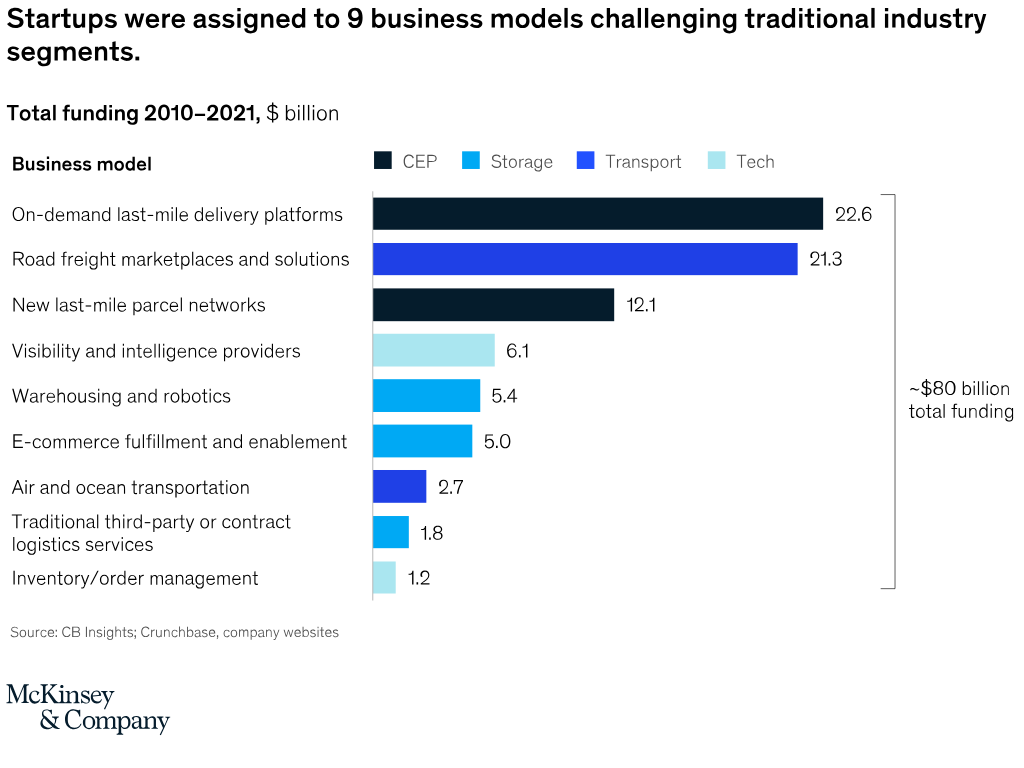
Growth in total funding from 2010-2021 across business models. Source: McKinsey & Company
2020: North American and European FreightTech companies combined saw $12.6 billion from VC in 555 deals. Notably, Nuro secured $500 million in its Series C round, and Uber Freight acquired Transplace after a significant funding round. Valuations for startups surged, with pre-money valuations reaching $30 million for early-stage ventures.
2022: A changing landscape as consumers reverted to pre-pandemic norms. Economic pressures from international conflicts, especially the Ukraine-Russia tension, alongside interest rate hikes, influenced VC sentiments. Acquisitions began to overshadow IPO listings, revealing the industry's appetite for cash.
2023: The VC enthusiasm wanes. Recent data suggests a nearly 70% dip in deal value for supply chain tech firms. The freight tech segment's projected earnings fall below 25% of its 2022 figure. As VCs prioritize 'forced investments,' startups face tougher deal terms and greater founder dilution.
While challenging times lie ahead, industry insiders remain cautiously optimistic. Supply chain disruptions persist, prompting 77% of senior supply chain executives to invest in visibility. Plus, with e-commerce predicted to grow by 50% over the next four years, there's hope for the future of freight tech.
As freight slowed starting ~ Mar 2022 we reduced our team by 50% over the next 12 months, culminating in a major service tech/team release in Q1'23. Our costs got much lower and our service better...we had inbound interest so we didn't cut further or pivot. We did expect the…
I’m Adriana, a writer and editor at FreightCaviar. I’ve covered everything from freight tech to industry lawsuits and market shifts, helping scale us to almost 14K subscribers. My goal: to make logistics stories digestible, clear, and fun to read.
Freight brokers are measuring their inboxes wrong. Most inbound email is monitoring, not work. And the longtail categories that look like noise are costing real margin. Here's how to audit what's actually in your inbox, and why it matters in 2026's margin-first market.
Learn how freight brokers can source vetted carriers faster using real lane activity, invoice-backed rate intelligence, and proactive fraud monitoring through OTR Select
Keep up with the freight broker world in 5 minutes.
Join over 14K+ subscribers to get the latest freight news and entertainment directly in your inbox for free. Subscribe & be sure to check your inbox to confirm (and your spam folder just in case).