66% of logistics pros say talent quality — not cost — is the #1 factor in choosing a nearshore partner. Rapido's integration model explains why that's the right question to be asking.
Plus, a carrier pleading guilty to mob money laundering while still FMCSA-active, Iran's first post-ceasefire attack and what it means for diesel surcharges, FedEx Freight's first earnings as a standalone company, and more in today's newsletter.
Freight brokers are measuring their inboxes wrong. Most inbound email is monitoring, not work. And the longtail categories that look like noise are costing real margin. Here's how to audit what's actually in your inbox, and why it matters in 2026's margin-first market.
FreightWaves: The Great Trucking Recession Is Still Here — and May Be Worse Than 2008
FreightWaves contributor Adam Wingfield argues that trucking remains in a “Great Trucking Recession,” with suppressed rates, bankruptcies, and structural challenges hitting small carriers harder than 2008.
According to a new FreightWaves analysis by Innovative Logistics Group's Adam Wingfield, the current downturn meets every definition of a true “Great Trucking Recession” — and for many small carriers, it may already be worse than the collapse of 2008.
The Strain on Carriers
Wingfield writes that operators don’t need SONAR data to recognize the downturn. They feel it in mounting deadhead miles, sub-$2 spot rates, and truck payments that no longer align with shrinking margins.
FreightWaves points to SONAR’s National Truckload Index (NTI), which has fallen from above $3.00/mile during the pandemic peak to roughly $2.27/mile today. Tender rejections hover near 5%, a classic oversupply signal, while bankruptcies and truck repossessions continue to climb.
How the Market Got Here
The analysis highlights how the COVID freight surge set the stage for today’s contraction. Carriers expanded aggressively as spot rates soared, and new authorities surged at record pace. Many of those entrants were inexperienced operators, while the influx of non-domiciled CDL holders further reshaped the labor market.
When volumes normalized in 2022, capacity far outpaced available freight. Elevated insurance, fuel, and equipment costs left carriers exposed, turning what might have been a cycle reset into a prolonged contraction.
Why This Downturn May Be More Severe
FreightWaves argues this cycle is different from past recessions. The downturn is compounded by:
Tariff uncertainty. Importers front-loaded shipments ahead of tariff deadlines, creating temporary port volume spikes but leaving inland freight flows weaker weeks later.
Regulatory pressures. Enforcement of English Language Proficiency standards and scrutiny of non-domiciled CDLs are creating new compliance costs and raising questions about driver supply.
Spot market erosion. Unlike in prior downturns, the spot market no longer offers a fallback. Load-to-truck ratios have dropped 30% year-over-year, and spot rates remain consistently below contract.
This, Wingfield notes, means carriers can’t simply “out-hustle” the market as they might have in past cycles.
Looking Back at Fuller’s 2024 Call
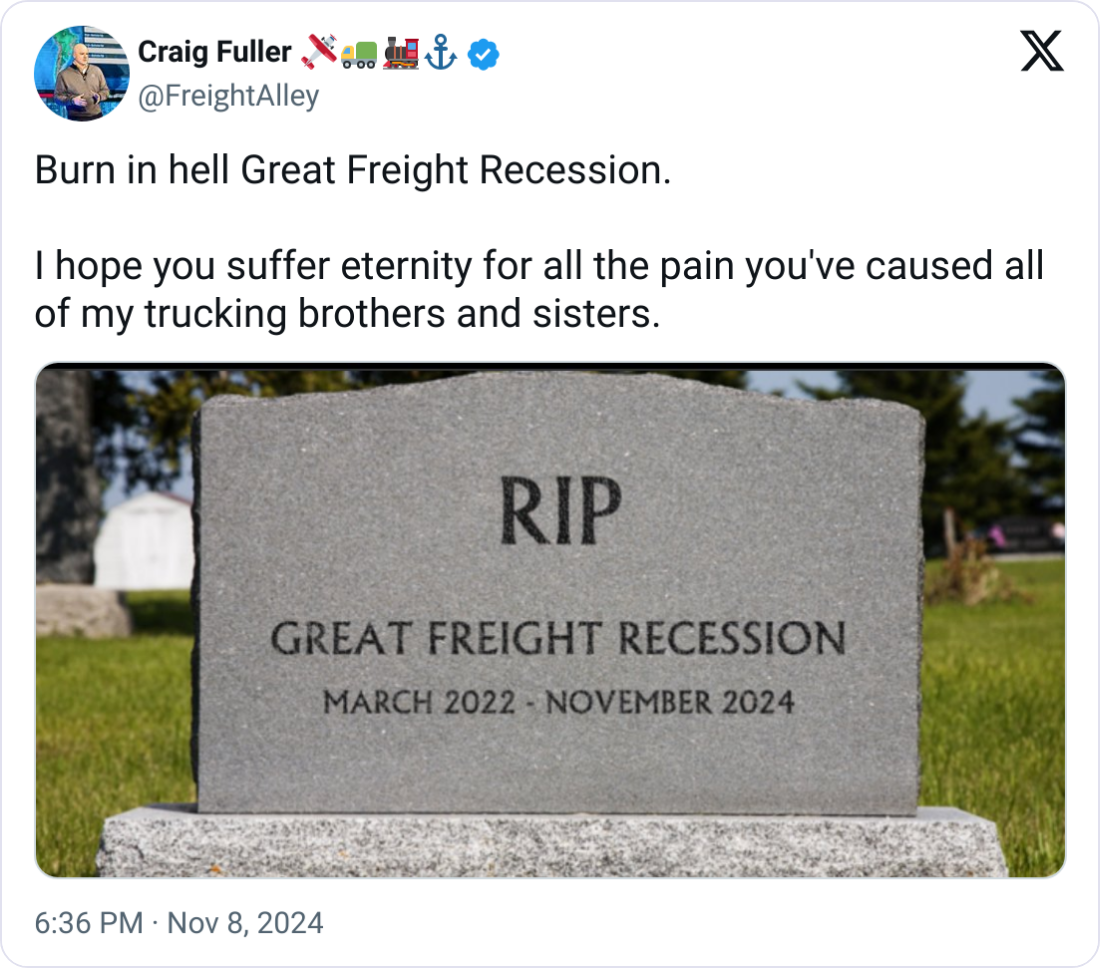
The latest FreightWaves commentary stands in contrast to earlier optimism. In late 2024, FreightWaves CEO Craig Fuller declared the end of the “Great Freight Recession,” citing rising tender rejections, higher spot rates, and regulatory changes that threatened to tighten capacity.
At that time, conditions suggested recovery was underway. Yet nearly a year later, with rates still suppressed and bankruptcies accelerating, Wingfield’s assessment is that the recession never truly ended — it merely shifted into a slower, more grinding phase.
FreightWaves’ Current Position
FreightWaves concludes that trucking is still in the grips of a multi-year correction. The downturn is forcing carriers to rethink operations, with survival hinging on cost discipline, direct shipper relationships, and leaner business models.
Whether this period ultimately proves deeper than 2008 remains to be seen. But for smaller fleets, FreightWaves suggests it may already be more painful.
Hello! I'm Jerome FreightCaviar! I’m into the politics of freight and the impact it will have worldwide. I'm always eager to learn more. Follow me on X @JeromeFreightC
Alvys raises $40M Series B to expand its AI-powered TMS, aiming to streamline freight operations with automation, integrations, and real-time decision support for brokers and carriers.
FreightWaves data shows truckload haul lengths hit an all-time low of 522 miles in August. With shorter hauls, EV adoption becomes more practical, adding a new dynamic for freight brokers.
Keep up with the freight broker world in 5 minutes.
Join over 14K+ subscribers to get the latest freight news and entertainment directly in your inbox for free. Subscribe & be sure to check your inbox to confirm (and your spam folder just in case).