66% of logistics pros say talent quality — not cost — is the #1 factor in choosing a nearshore partner. Rapido's integration model explains why that's the right question to be asking.
Plus, a carrier pleading guilty to mob money laundering while still FMCSA-active, Iran's first post-ceasefire attack and what it means for diesel surcharges, FedEx Freight's first earnings as a standalone company, and more in today's newsletter.
Freight brokers are measuring their inboxes wrong. Most inbound email is monitoring, not work. And the longtail categories that look like noise are costing real margin. Here's how to audit what's actually in your inbox, and why it matters in 2026's margin-first market.
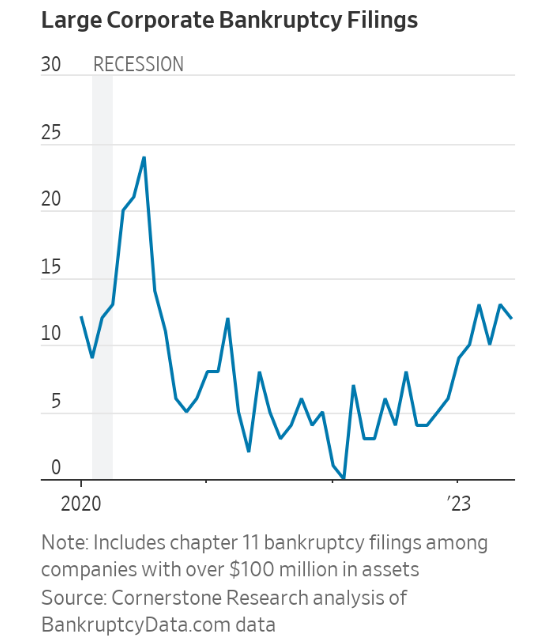
In a year marked by uncertainty, businesses of all scales are navigating treacherous waters. Major corporations, from SVB Financial, Bed Bath & Beyond, and even the trucking giant Yellow, have sought chapter 11 bankruptcy protection. Their reasons?
Economic Challenges: Elevated inflation, higher interest rates, diminished government aid, and enduring supply-chain disruptions.
Debt Backfire: Many businesses that once capitalized on low-interest rates are now ensnared in the financial repercussions of growing interest.
Big chapter 11 filings have tripled in the first half of 2023 compared to the same period last year. Source: WSJ
Large-scale business bankruptcies, often referred to as "mega bankruptcies," are not merely indicators of corporate distress but also significant red flags for the broader economy.
Ripples Through Financial Market: For instance, the bankruptcy of SVB Financial Group, with nearly $20 billion in assets, instigated fears of a recession, compelling the Federal Reserve to intervene and stabilize the markets.
Massive Job Losses: A single major corporate collapse can result in tens of thousands of job cuts. Yellow's bankruptcy led to the loss of around 30,000 jobs.
Potential for Recession: Although the current rise in bankruptcies doesn't suggest an impending "doom-death loop," some analysts, like Steven Blitz, chief U.S. economist at GlobalData TS Lombard, feel that increasing bankruptcies combined with a weakening stock market and escalating credit-card delinquencies may be precursors to a recession.
However, these corporate struggles aren't limited to traditional sectors. DTC (Direct-To-Consumer) businesses are also feeling the heat. Two major public DTC companies—Smile Direct Club and Blue Apron—have recently declared bankruptcy or sold for a fraction of their peak valuation.
Smile Direct Club: Valued at almost $9B in its 2019 IPO, but filed for bankruptcy after reporting an $86mm loss in 2022 and a 19% decline in Q2 ‘23.
Blue Apron: Once worth over $3B, it's now selling for just $103mm, having lost $110mm in 2022 and shrunk by 15% in Q2 ‘23.
Further analysis of public DTC brands reveals several others, including Allbirds and Purple, that check similar boxes of unprofitability and declining revenue, painting a concerning picture for their future.
I’m Adriana, a writer and editor at FreightCaviar. I’ve covered everything from freight tech to industry lawsuits and market shifts, helping scale us to almost 14K subscribers. My goal: to make logistics stories digestible, clear, and fun to read.
In a recent episode of the Stay In Your Lane Podcast from Triple T Transport, Allianz Trade North America Chief Economist Dan North shed light on why the anticipated economic recession hasn't yet materialized and its implications on the freight market.
Keep up with the freight broker world in 5 minutes.
Join over 14K+ subscribers to get the latest freight news and entertainment directly in your inbox for free. Subscribe & be sure to check your inbox to confirm (and your spam folder just in case).